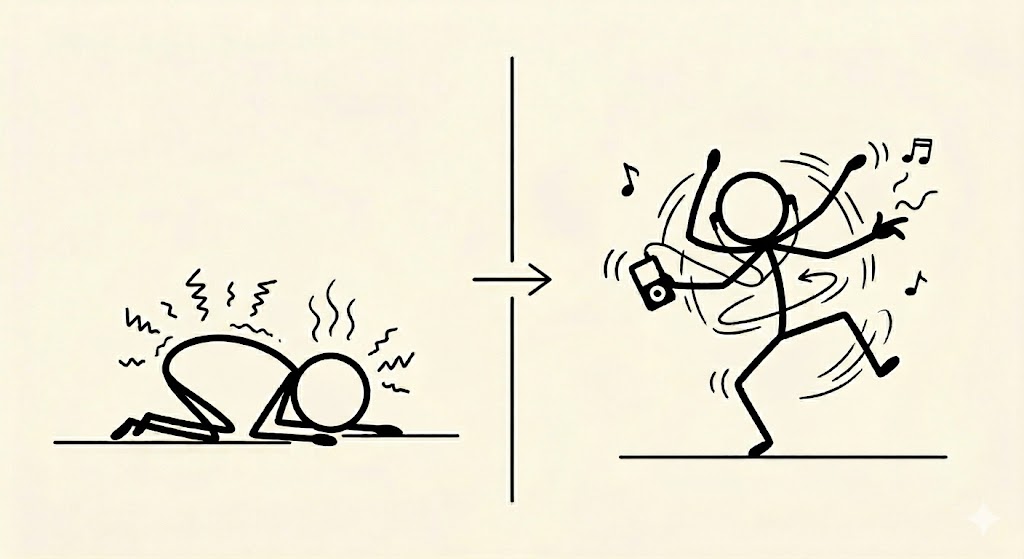
I laid on the floor in a heavy state as a dark wave of depressive fatigue and heaviness washed over me. A massive pressure weighed on my head, and that characteristic optimism telling me there is always a way out, reframe or way to step back to see the bigger picture, seemed to be failing me. I didn’t see a way out of what was happening to me: the seeming hell of a mind viciously swirling in an anxious and disturbed spiral; the same hell that Vipassana meditations had so kindly reacquainted me to several months prior in Koh Phangan. Yet, I was frozen and encroaching into deeper and darker psychological ground. Luckily, having been introduced to Richard Schwartz’s Internal Family Systems (IFS) model, I had a new vocabulary for these occasional emotional overloads; at this very moment, I was firmly in the grips of a firefighter shutdown.
IFS provides a useful toolkit, when applied mindfully, to notice familiar patterns or feelings when they are happening. In turn, it provides a signal about your internal ecosystem to your conscious brain. In IFS, there are a group of parts called “exiles” which according to Schwartz, are the disowned parts of us that we cast out of our happy little internal family. This is done to keep the illusion of peace but more often as a survival strategy navigating the world. The problem is, when an exile is poked or an uncomfortable feeling is belaboured upon it without care, our protective parts show up. First comes the managers, then the firefighters.
As I started to notice these feelings, and what it meant, I inquired to myself:
“If this is a firefighter, what is it trying to protect me from? What’s the exile or feeling it’s trying to get me to avoid?”
An internal voice, having apparently received my metaphorical tennis serve, shot back with: “I miss her”. “Her” refers to a broken connection I had been grieving for the prior few months, and felt I should “rightfully” be over by now. Unfortunately, internal emotions don’t seem to be punctual to assigned timelines. At this moment, I wanted to tear up and weep but my body felt unable. Frustrated, I resigned myself to laying on the floor once again, in hopes that I could convince myself, in earnest, that this wave of emotion, the ebb and flow of being human, would not last forever. Yet, in the next instant I felt the desire to yell and roar; with the pressurized container walls closing in on me, the animal side had apparently woken up. But before If move onto what happened next, an IFS manager in me insists on explaining the science behind some of what is going on.
When deep emotional pain hits, the brain registers it along some of the same pathways as a physical injury. A real, measurable surge of adrenaline, noradrenaline, and cortisol hits the body as it braces for a fight it can’t have. Polyvagal Theory has an explanation for when this happens: when you can’t fight or flee, the dorsal vagal system slams the brakes and locks you into freeze instead. That’s the science. But it doesn’t explain why some people stay stuck long after the initial activation is gone.
For that, we need to turn to Peter Levine. In Waking the Tiger, he argues the chemical cocktail doesn’t just dissipate when the freeze lifts, it can stay trapped in the muscles, which is what ongoing tension and edge are: a nervous system still bracing for a pain that’s already over. But that description isn’t new, it turns out. Long before Levine had a lab, Hindu and Yogic traditions had already named the same residue: samskara, or granthi, literally “knot”, a blockage that gets re-activated by something as innocent as a song or a smell or memory. Michael Singer writes about this in The Untethered Soul, and reading him next to Levine felt less like two separate fields and more like the same observation in two different languages. Levine’s research showed what resolving it looks like in the wild: after a predator encounter, animals shake for minutes, visibly burning off the leftover charge before walking away unbothered. Humans carry the same wiring, we are mammals afterall. We’re just conditioned out of the shake instinct. And when even movement is taken away entirely, the pressure still needs a place to exit. Sometimes the only way left is through language.
In the dramatized film inspired by his life story, Get Rich or Die Tryin’, Curtis “50 Cent” Jackson, plays Marcus Grier, a convicted drug-dealer sent to prison where he eventually chooses to turn away from criminal life to pursue his passion for music . The turning point of the film sees Grier in solitary confinement. A razorblade is dropped into his cell window as a message, but for Grier, it represented a catalyst towards survival:
”I had to express myself or die”
Grier (Curtis Jackson) says, as the camera pans over a dark room with the solitary man etching his personal pain and struggle for survival lyrically in stone.
Expression is often miscategorized by head-heavy analytical personalities like me, and in modern culture, it possesses a natural assumption toward the audience. We tend to think expression means giving a beautiful vocabulary to our suffering and to have an intellectual understanding of where it comes from. That by wrapping linguistics around the crying little boy or girl inside, we can then parlay that to a listener, reader or audience in hopes that it helps us. But expression, at its base, has not always possessed this definition.
The English word “express” traces its etymology to the Latin verb exprimo, which literally translates to “press out” or “squeeze out”. To communicate, for example, you have to mechanically “squeeze” thoughts out of your head and shape them into distinct, clear words, like pressing a seal into wax. Yet, in modern culture we tend to view expression in vain terms, through a permanent lens of aesthetics rather than physical mechanics. We believe we need an audience to express to, in order to express at all. A more whole view of expression perhaps captures not only communication but discharge, like squeezing juice from a fruit. That is to “express oneself” is a literal act of squeezing out internal experience, sometimes in a deeply pliable and ugly way.
Resolute to not fall further down the spiral that pulled me near, I stood up from the floor and reached out to a lifeline. As I slid my 2000s style MP3 player into my pocket, fixed the rugged ear buds into my ears and closed my eyes, I hit play. The music began, and I started to swing my arms slowly, then violently in the air as I moved my feet back and forth. Stomping on the ground, jumping up and down, I spun in circles hoping I wouldn’t knock any furniture over. Feigning the voice of my inner critic, commenting on how idiotic (or genuinely unstable) I looked, I continued the motions as my inner compass commanded. Did I want to move my left foot now? Great. Right arm swings wildly across my body, nearly hitting myself in the face? No problem.
Yet, as I engaged in this playful, childish and deeply ugly practice of intuitive movement, I slowly felt ease begin to wash over me and a smile form in my face. No words, just sounds, un-dignitified faces, flailing, and uncoordinated movements. A beautiful chaotic symphony of squeezing out the quiet voice, expressed in awkward movement, of an exiled part of me which felt dissatisfied with a written statement about discomfort. Several minutes passed and after my final hop, turn and spin, followed by the final kicks to Tommy Vicari’s In The Night, I felt myself come back to my present surroundings ~[8]~. I opened my eyes to a familiar view but a renewed inner landscape. The heaviness of grief, weighty pressures of expectations, and boxes created by my mind felt lighter ~[7]~.
This practice of what science calls “somatic discharge” is recognized as humanity’s oldest form of medicine. Long before modern neuroscience, cultures worldwide used intuitive, uncoordinated movement, such as shamanic shaking and rhythmic trance rituals, to process what words failed to touch. Historically, wild flailings, spinning, and guttural noises were viewed as a necessary spiritual expulsion, making it a literal, cross-cultural exorcism of pain. It is the body’s raw, primal and evolutionary intelligence executing motor patterns necessary to excavate stress and keep you functioning; and it is beautiful in a very very ugly way. Allowing one’s body to “take over” the floor, you step directly into a timeless historical lineage of somatic based healing. Yet this surrender to a peculiar method of self-regulation, is often frowned upon outside of sanctioned events, despite its efficacy growing in therapy methodologies over the years [5].
This solo, private release, however, I’d already experienced collectively months earlier, just in a room full of strangers.

The Sunday afternoon humidity of the Koh Phangan jungle was unbearable. I trekked step-by-step up the near vertical path adorning my 500 baht flip-flops, and now soaking in a path-to-enlightenment t-shirt and shorts. The path ahead looked more like a death wish than a road, but many seemed to scooter their way up, in one piece. Happy to have summited the death road, I heard a familiar sound of a thumping 909 kick drum held in the distance along with a view of a massive pyramid erected within the trees at Pyramid Yoga’s yoga center ~[6]~. The atmosphere of Pyramid’s weekly Sunday Ecstatic dance held strong, alongside my anticipation. A ceremonial cacao in hand amongst a burgeoning collective of “tuned in” folks, the reverberation of a driving four-on-the-floor rhythm beaconed me to the dance floor.
Ecstatic dance is a free-form movement practice where people dance without choreography, steps, or a partner, just pure response to music and their own body, without talking, substance use, or (thank god) mobile phones. The modern ecstatic dance scene is associated with cities like San Francisco and is held typically with spiritual/cathartic intent: a way to process emotion, get into a trance-like or meditative state, or just get out of your head and into your body. People spin, roll, or perform playful dance improv games with one another, with eyes, smiles and open glances passing around the room. Together, whether they realize it or not, they stack a further element to our common humanity: co-regulation. Co-regulation is when nervous systems sync through shared rhythm (e.g., heartbeat, breath, arousal level) entraining to those around you. It’s why group dance, ritual, and therapy feel calming: you borrow nervous-system stability from others until you can hold it yourself (no wonder we reach out to others [1]).
As the hours passed and DJ signaled the crescendo to this musical movement, sweat covered bodies from many places, with different colours, physical attributes and faces throttled into a descent [3]. A collective symphony of vocalizations, sighs, and auditory release dissipating the tension of the all-afternoon dance session. Everyone moved in Zen-like calm to the exit, with exchanges of embraces, “nice to see you”, and “see you next time”, as the artisans packaged up their clothes. Like some sort of collective exorcism had just occurred, and now everyone was back to their everyday waking life. Every Sunday, this ritual happens in the mosquito infested jungle on a small island in the Gulf of Thailand; a dropping of the mask of “I’ve got everything together back-to-back Zoom calls” into animalistic, communal co-regulation.
As a DJ for 14+ years, I’ve always loved to dance and mix music [9]. Familiar memories ranging from practicing how to shuffle in my university dorm room, to late night sessions in the open air of Berlin’s clubbing scene. The throughline in all my experiences has been: something real is going on here inside me when I dance and move. I’ve often felt some of the most profound revelations I’ve had, happened on the dance floor. I’ve found, released, and lost love, sadness, anger, loneliness, fear, ordinariness, authenticity, fun, and more on the dance floor. I’ve encountered my own ego, vanity, envy, comparison, fear of not belonging and inadequacy too. But, through all these emotional expressions, the kick drum keeps sounding so you keep on grooving ~[2]~.
Yet, I know none of this would be possible if the fear of looking foolish or stupid overrode the emotional joy felt when a rhythm catches me, and the bodily desire to move. If we shame ourselves in avoiding embodied movement, whether aesthetic or uncoordinated [4], we cut ourselves off from an oxygen to breathe and thrive in our emotional world rather than just survive it. I have always found those most entrained to dance, tend to be the most comfortable with themselves: their shadows, light, darkness, foolishness, joy. They take themselves seriously enough to know that you’ve got to shake it sometimes in life, but not so seriously as to forget that dance is ultimately not about aesthetics, but about personal and human transformation.
My intuitive dance didn’t make me stop missing her, or the grief that comes with her. But it stopped me from silencing the part of me that does, and the part that needs to explain, analyze, think it through. She still turns up in my thoughts, usually uninvited, now and then, but I just try to dance with her now, rather than just pretend.
Footnotes
[1] See Fear, Cold & Connection
[2] DJ Sneak – Keep on Groovin (Pitch Disco Edit)
[3] The Streets – The Weak Become Heroes
[4] So long as it is not harmful to self or others.
[5] See The Body Keeps the Score
[6] See Pyramid Yoga
[7] See Who Are You When You Stop Becoming?
[8] See Tommy Vicari’s In The Night
[9] See learningtodj.com
Pingback: The Ministry of Self Improvement: discipline, the body & the tyrant underneath - Robert Simoes
Pingback: Ain't No Economy Like the Attention Economy: On Leaving (But Never Actually Leaving) - Robert Simoes