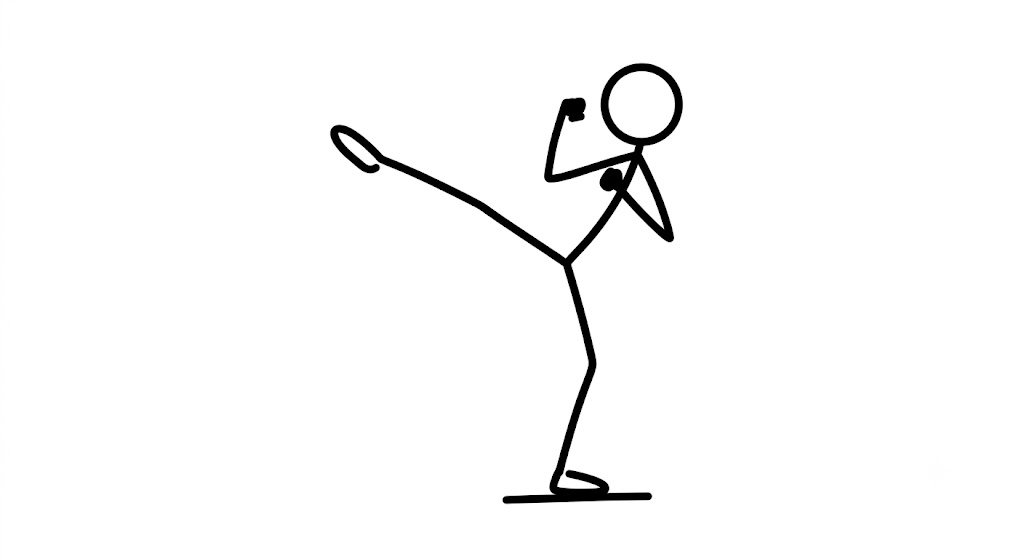
The blunt force of padded knuckles and shins sounded again and again landing on the pads, as the pad holder called out:
FOUR!
Bang bang bang bangELBOW!
bangCROSS. LOW KICK!
bang whackDOUBLE KICK!
Whack whack
Finally, with a resounding sense of completion in final sequence called out:
TEN KICKS!
Whack whack whack whack whack whack…
With the assault complete, my heart felt just about ready to explode out of my chest. But, before I could catch my breath, Kru Top ran to the push sled, standing on top of it and yelled out to me:
TAXI TAXI!
I pushed the 75kg fighter across the gym and back in genuine difficulty, as sweat poured from my body and I gasped for air. Yet, Kru Top’s amusement from his taxi trip was short lived, as he now stood by the heavy bag and called out my next task:
100 KNEES!
I made it to maybe 75, and then collapsed to the floor in the brutal humidity of Pai’s Northern Thai climate.
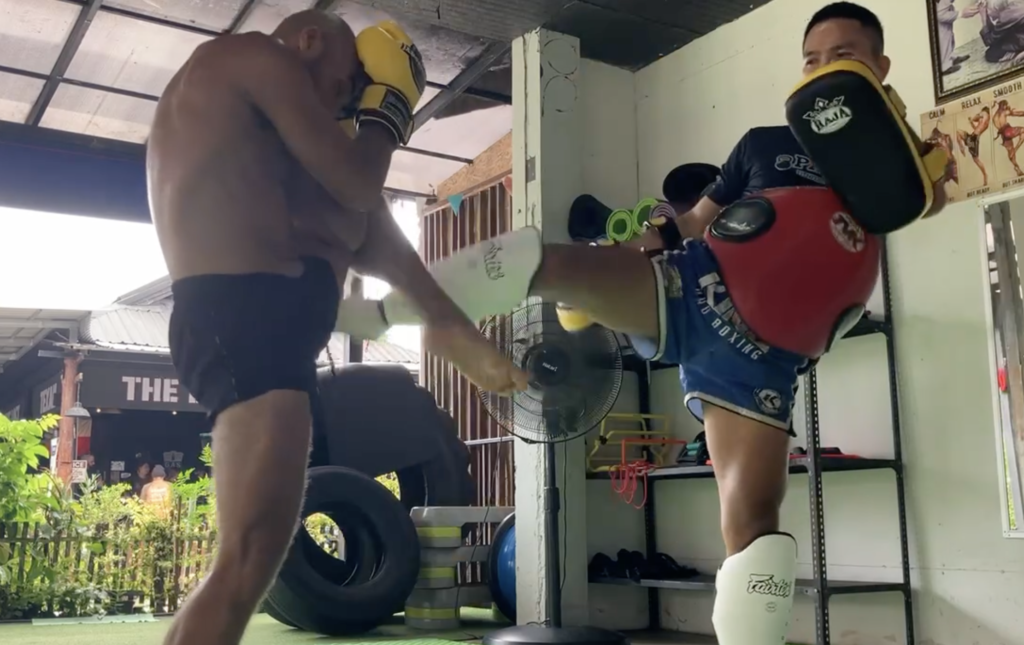
Lying there, staring at the ceiling as my chest heaved, my mind was still. The same hollow, ego-less quiet I had chased for hours on my Zazen cushion, but delivered brutally, through physical exhaustion. At the threshold of intense physical challenge, I have often found a strange kind of peace.
Muay Thai is the traditional martial art and sport of Thailand, translated as “Thai boxing”, and the spiritual successor to Muay Boran, an umbrella category of unarmed ancient martial arts in Thailand. Widely considered among one of the more brutal striking sports for its intense conditioning, extreme volume, and enduring athletic asceticism, it also possesses a deeply transformative dimension.
As I laid on the floor, Kru Top demanded 50 sit ups, with interspersed blows from the pads into my abdominals to simulate receiving body hooks. The way to absorb a body blow to is exhale heavily while flexing your abs, which is coincidentally how the Nak Muay (or Nak Muay Farang; “boxer” and “foreign boxer”, respectively), must posture themself throughout an entire Muay Thai bout. It’s not comfortable to be hit over and over again, but at the threshold of difficulty and activity, you find endurance. Yet, for all this seeming self-violence, to practice Muay Thai, like any martial art, is a deeply spiritual experience and endeavour to find the edge and dissolution of self. The intertwining of spirituality and martial arts is an ancient connection and necessity, and without it martial arts ceases to be art and becomes simply violence.
The fingerprints of Thai spirituality, primarily Theravada Buddhism, are deeply present in Muay Thai. A Nak Muay, sometimes surrendering their birth name to their gym in a first act of ego detachment, steps into the ring adorning the “Mongkhon” (headband; 3) blessed by a Buddhist monk or master, and Pra Jiads (arm bands; 4) promising good luck and a reminder of their family’s love and protection. Before the first fight bell is rung, the boxers perform Wai Kru Ram Muay (5). First, a prayer to each corner honouring their parents, teachers, gym and everyone who passed the art down to them, many fighters fight for survival to bring money home to their rural village. This is followed by Ram Muay: a slow rhythmic dance intended to banish bad spirits and ensure a safe, honorable fight. Yet this connection between something bigger than self and combat is not unique to Thailand. While I haven’t stepped onto other mats yet, watching from outside, the same architecture seems visible to me in other martial disciplines.
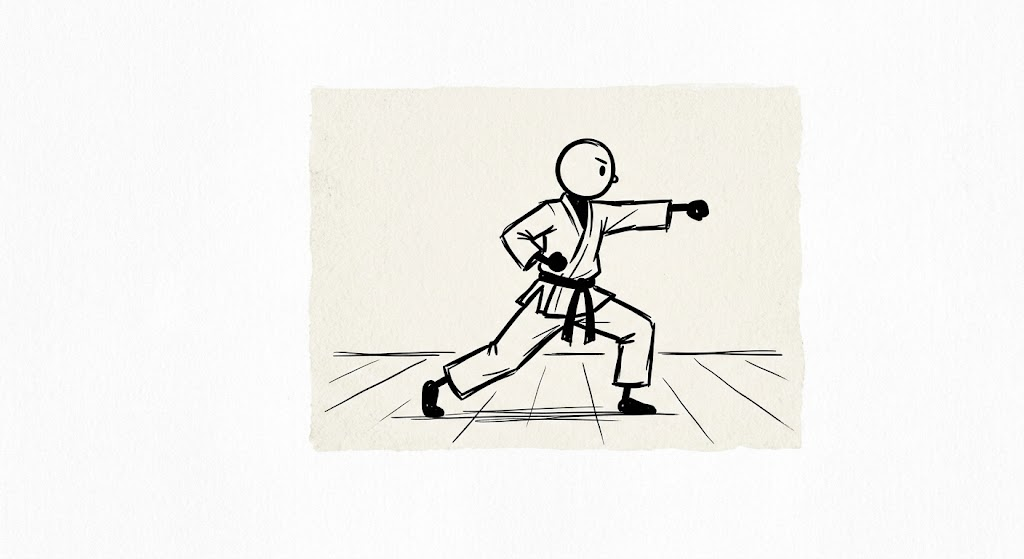
Karate is a martial art developed sometime in medieval Okinawa. While not originally Zen, in the early 20th century masters brought the art to mainland Japan, where it was infused with Zen philosophy (7). The Zen concept of Mushin, No-mind, represents a state of mental emptiness and a peak practice in Karate Do (1). The karateka must inhabit a mind free from anger, fear, ego, and thinking to achieve the flow state and react intuitively to danger without a conscious interference. Zanshin, on the other, is the concept related to “lingering” or “remaining” mind: a state of continuous awareness before, during and after an action; the karateka must not relax after executing a strike, in case of counter-attack or other threats (2). In embodying these traits, a karateka moves through a kata, a series of movement patterns, in a manner of moving meditation not unlike the Zen disciple raking sand (6) or my experiences in walking meditation. This combination of gentleness meeting power is found in other martial arts too.
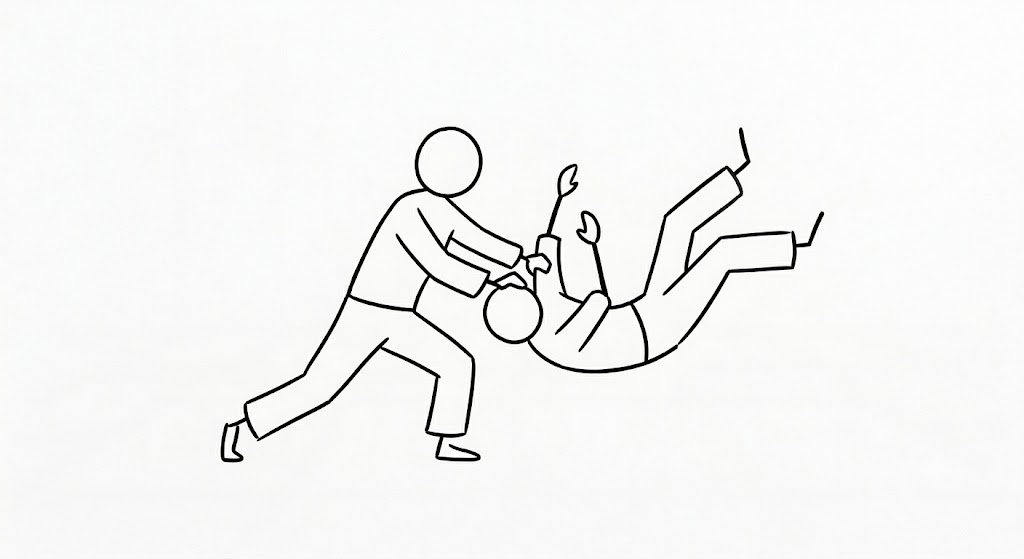
The modern Judo movement, arriving in 1882 from Jigoro Kano, evolved from the ancient Japanese martial art of Jujutsu. Judo is a combination of two characters: Ju (柔): Meaning gentle, yielding, or soft, and Do (道): meaning the way, the path, or the journey. The combination of two is sometimes called to “the gentle way” built on two core principles: Seiryoku Zenyo (9) and Jita Kyoei (8). Seiryoku Zenyo locates the idea of maximum efficiency and minimum effort, the usage of the opponents momentum to throw them, whereas Jita Kyoei refers to the act of mutual trust, respect and benefit in your partner; or more pithy: you cannot practice Judo without a partner, so individual progress is meaningless unless it is used to elevate others or society. And yet, on many days, that kind of partnership has felt far away for me.
On the other side of the world, Western boxing rarely names this dimension of combat in the way Eastern martial arts do. There’s no Wai Kru, no word for Mushin, but the principles are not absent. Cus D’Amato, the trainer behind Mike Tyson and Floyd Patterson, spoke of boxing as a process of stripping away ego and self-protection to find what lies beneath, and of fear itself as something to be humbled before rather than eliminated. The blueprint is the same. It’s simply less legible, privatized in a gym rather than built into a public ritual, which I think North American cultures lose something in, but at least it is there.
In all four examples, I see martial arts as a vessel embodying something approaching sacred rather than competition and skill alone. Competition might be a test, but I feel there must be a reverence to the higher wisdom contained in a combat practice. That martial arts can also lead to a form of conscious living, not unlike meditation or yoga, if you can differentiate ego-driven, domination and competition from the practice itself (10). The art being: how a practice grinds down the “me” into something much smaller and humbler, yet precious and spacious. As Shaolin master Shi Heng Yi puts it, “You cannot perfect the martial arts, you can use martial arts to perfect yourself” (11). If we forget this core aim of martial arts, instead fixating on competition, when the spirit of the practice is lost, the form descends into an ugly thing; there is something to the solidity of mastery and self-possession contained in martial arts that reaches beyond beating an opponent..
If I were to lie to you, I would tell you I have felt a sense of belonging throughout my life. But the truth is that, I have known great loneliness for long stretches. I’ve often found it challenging to relate to the hyper-distracted hum of modern life, preferring instead the words of dead writers, philosophers, and masters. Alternatively, seeking company in nomadic travel or conscious adjacent communities focused on urgent questions of meaning and understanding. There is something to the quiet epidemic of loneliness in modern life captured in Nick Curly’s remix of Introspection, that seems yearning to be filled with community. I have been lucky enough to find some of those during my time in Toronto, but it still feels there is a gap.
As I finished my conditioning circuit, unwrapped my hands and breathed heavily, Kru Top nodded in approval. In the background, the gym owner was cheering, and the smiling faces of new fighters were stepping up to entertain themselves with the exact same form of adversity. In that quiet, sweaty moment, I felt a profound sense of belonging and being. A realization that we can reach to a much larger version than our small isolated self, and that by committing to a practice, you can encourage another and maybe alter their life path forever. Maybe that’s the paradox I keep circling: I’m still the one who needs Mobb Deep blaring in ears and my heart at 100 just to find a way to the same emptiness the practice keeps quietly asking for. Softness, for me, seems to arrive often through the door of intensity. I’m not sure that’s a flaw, and I’m not sure it’s not (12), I’m not even very experienced in martial arts personally, but in either case, belonging to a group which resonates with that same internal contradiction is a strange kind of peace itself.
Footnotes
(1) Mushin and the Flow Theory
(2) Karate Concepts: Zanshin
(3) Mongkhon – The Muay Thai Headband Explained – Fighters Vault
(4) Wikipedia Muay Thai
(5) What is a Wai khru ram muay
(6) What is a Karate kata?
(7) Wikipedia Karate
(8) Jita Kyoei Pronunciation
(9) Seiryoku zenyo Pronunciation
(10) In addition to the technicalities, strategic elements and sportsmanship of competition.
(11) If I Started Learning Martial Arts In 2026, I’d Do This
(12) See What if More Peak Experiences Aren’t The Answer?
Pingback: The Ministry of Self Improvement: discipline, the body & the tyrant underneath - Robert Simoes