We stood facing the water basins as faux candles let out a soft glimmer in the dark room. Like a 1500s secret Gregorian chanting chamber (or potential incognito cult initiation), four rows of partnered pairs stood above individual plunging pools as sweat dripped off our bodies from the prior sauna session. Inhaling and exhaling deeply into the diaphragm we stared directly into our apparent fate: ice water.
Contrast is a fascinating phenomenon, in the absence of adrenaline it’s avoided, but with adrenaline some yearn and hunger for it – so what is there to fear about it? Contrast is despised because it upsets our equilibrium, causing a recalibration in state; we perceive it as an annoyance in mild cases and agony in others. However, it’s only the resistance to the change, transitioning to the contrasting state as it were, the barrier between what one wants and what is, where mental suffering and neurosis seem to live.
Krishnamurti taught me that, at base, the craving and anxiety of the mind are born from a fruitless search to untangle this paradox: security does not exist, yet the mind (the “me”) exists on the basis that it does. The mind conceives of a particular state, be it: economic status, relational state, level of power, the opium of achievement, or spiritual transcendence – and places all its hope in it; hope that this thing will solve the problem of impermanence – which isn’t a problem to solve but a fact.
“Life is not a problem to be solved, but a reality to be experienced.”
S. Kierkegaard
At the precise moment the mind conceives of one island of psychological security to latch onto, the ocean of instability begins to work each lapping tide towards decay: presenting the contradiction and what is.
At the Feet of the Master II
M: The “Me” I: The Inquisitor
M: I want to achieve success, a position of power and influence.I: Why do you want to achieve this?
M: Then I will have validation and acceptance of the tribe.
I: Why does that matter?
M: Then no one can hurt me or disrespect me
I: Why do you not want to be hurt?
M: Because it is painful I: Why do you wish to avoid pain?
M: Pain is suffering.
I: Why do you avoid suffering?
M: Because I have felt it before and do not wish to experience it again.
I: Why do you not wish to experience it again?
M: Because I am afraid, I will not know when it will end
I: Why are you afraid if you do not know when it will end?
M: Because then I will just be alone with the suffering forever.
continues…
Eventually, standing on but a single grain of sand, rather than accepting the fact of what is, we jump from one substitution to the next. What we fear is the unknown – finding security as the known; not in concept but in tangible form. The blackness of a dark room causes our senses to go wild turning gears endlessly in a circle manufacturing meaning; we do not know how we can face what we do not know. Only after we experience some innocent form of terror, the vulnerability and helplessness of the situation, do we solidify that into resin and carry it in our pocket. The “known” is held up then to each new encounter in comparison: “Will this bring me back to that dark and terrifying place.. will I have to experience that alone again?”
…continued
I: Why do you fear being alone with the suffering?
M: Because then I will be forced to look at it.
I: Why do you fear looking at it?
M: Because I am afraid
I: Why are you afraid?
M: Because I will see that it is always there.
I: Why does that trouble you?
M: I see that no matter what outward substitute I choose, it will always be there.
I: So, you are seeking for security from this suffering. There is a state of non-suffering and a state of suffering; you cling to the state of non-suffering but in doing so, by defining the state of non-suffering in and of itself, you create the state of suffering too – do you not? To define positive is to consequently create negative.
I: No matter what outward grasping you make towards this state of non-suffering (security) it will, by your very seeking, always remain there. This must mean, the state of non-suffering is a contradiction, an illusion. Seeking for security psychologically, a permanent remedy to the buzzing of the “Me”, creates insecurity. Therefore, to liberate oneself entirely, to free the mind, to be free from Mind & Me, is to see security and insecurity for what they are exactly.
I had never done an ice bath before, just cold showers from time to time. However, as the Othership guide commanded we plunge into the near zero celsius water, I felt compelled by the movement of the journey, surrendering into the unknown, voluntarily into fear, only the lifeline of the breath to guide me. We sunk in unison – my plunging partner, Hannah, a woman who I’d yet to meet until this now, and I.
Physical discomfort and pain are fascinating sensations that amplify the present; drawing seconds into their real weight. If you feel sharpness on your skin, a knife in whispering range of a small cut, your mind is fixated on that sharpness; in our case, the piercing cold in contrast to our sauna-warmed bodies. As I descended and closed my eyes focused on the chilling water and my breathing, from outside my inner world I could hear audible discomfort and resistance from my partner.
Jim Rohn once said:
“One of the most powerful words in the English language is “let’s”. It inspires a whole world of possibility.
Let’s do something about it.
Let’s build an enterprise.
Let’s win the game.
Let’s try to figure it out.”
The conjunction “let’s” implies we, us, together – it fires some ancient wiring in our brain that has and continues to enable humans to surmount seemingly impossible objects. It also, unfortunately, and when improperly used, can create more suffering than is bearable to even the bravest among us (1).
Let’s says: I’m just like you;
Let’s says: I’m here with you;
Let’s says: I’m scared too,
But maybe together,
We’ll make it through.
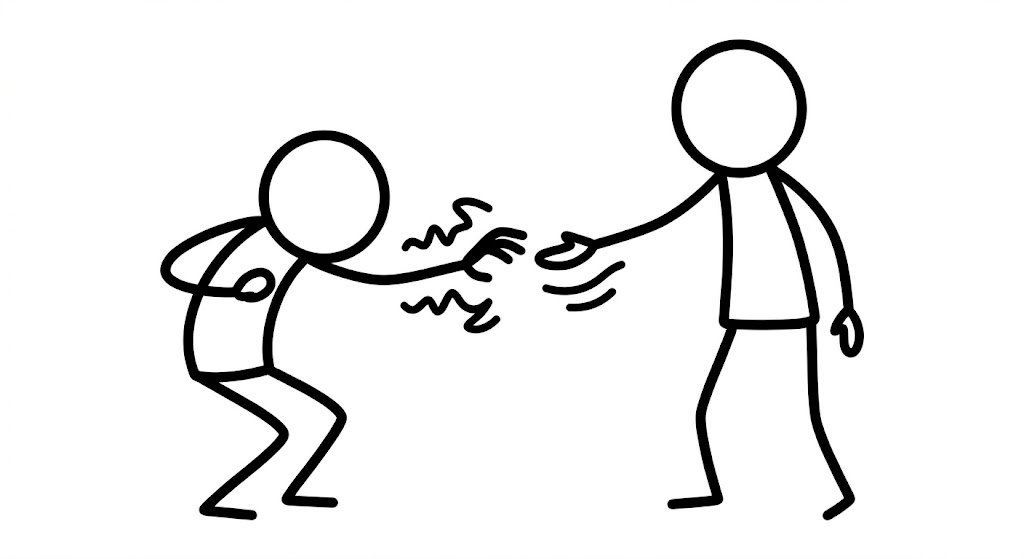
When you experience authentic fear in the face of the unknown – the terror of a motorcycle accident, a terminal diagnosis, trapped outside in -30°C weather alone – the organism doesn’t recoil in an armor of self-importance and pride – it reaches out desperately; because it doesn’t know what else to do. Instinctively, in what I assume was my discomfort and desire to connect, I reached out Hannah and she took hold of my hands as we sat in the tub silently wondering how much longer this would last. Skin hurting and feet going numb, as strangers we were alone… but alone together in this part of the journey.
As soon as the plunge started, two minutes faded and it was over. Shivering on the bench nearby, I watched as the next group prepared to enter the tank, observing the bodily sensations and musing on the ideas of Peter Levine and the animal response to trauma. When our “Guided Down” journey ended, I saw Hannah in the tea lounge and we exchanged small talk, yet things felt different. The aliveness of the NOW was gone. Parts of the “me” had resurfaced, quieter no doubt, but still audible in stirrings of becoming, striving, recollection of the past, my sense of achievement explaining how I found this place through prior work on the podcast. We parted ways thereafter as the facilitator ushered us in time to leave.
I don’t know if it’s possible to sustain the sense of “NOWness” without ritual, although, I already hear Krishnamurti screaming in my ear as a wise master would, rightly, discipline a pupil: “Nono – No!”. My view of “thusness” “now”, “it”, “presence”, “seeing clearly”, “aliveness”, whatever innumerable adjectives we’d like to paint this experience with, is something of a circular discipline. You don’t “reach it” as a mountaineer summits Everest but you come around full circle again and again; that is why all such disciplines are called “practice”. Yet, the practice somehow involves the unknown even to the extent of opening up to the possibility that what was, may no longer be what is.
I always wondered why when Jim said the following I felt a visceral reaction,
“Face your fears. That’s how you conquer them”
The expansion of the known into the unknown seems to be the blueprint for the development of the human psyche, and collective as well. The same profit the hero reaps in the motif of Joseph Campbell’s Hero’s Journey feels like the closest approximation to the most fundamental relationship between humanity, the individual, and meaning in the Universe.
However, in the face of the unknown, there are not “many” feelings, there is only one ancient and recurrent feeling: fear. Symbolically it is the serpent & chaos (i.e., Oroburus), and if we are honest with ourselves, truthful to the point of consequence, we are naked and alone no matter who we are, so… we reach out to each other.
Footnotes
(1) Weltschmerz (german literal: “world-pain”) is a literary concept describing the feeling experienced by an individual who believes that reality can never satisfy the expectations of the mind, resulting in “a mood of weariness or sadness about life arising from the acute awareness of evil and suffering”. Even Atlas shrugged.
(2) “The pain or writing is the pain of clarifying your thinking”
Pingback: Martial Arts without Spirituality is Just Violence - Robert Simoes