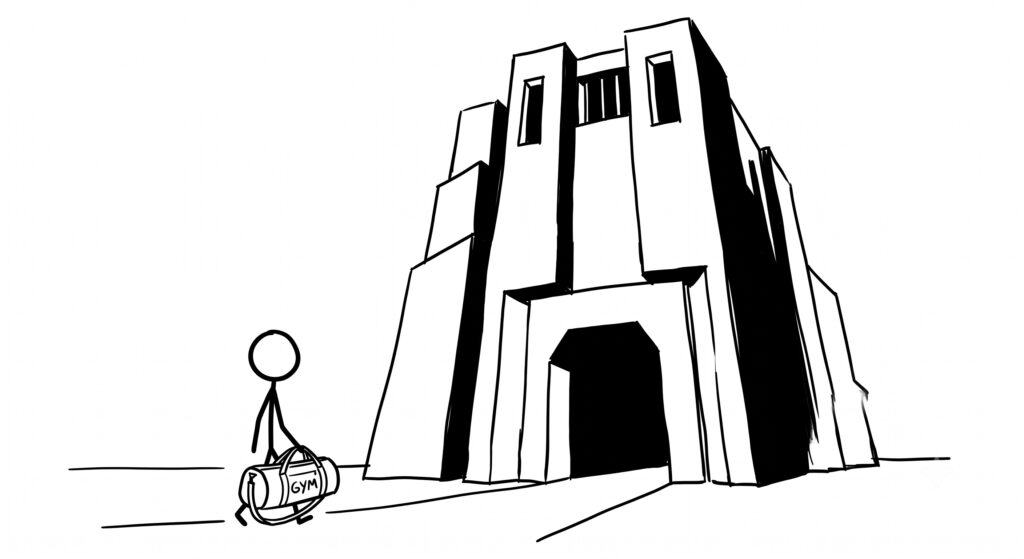
There’s definitely a self-destructive part of myself. That’s a guarantee. I feel like a lot of other people have it too, but I could be wrong about that. Jung seemed to think so though. He personified that place, the Shadow, which Robert Johnson playfully describes as:
“[the] unconscious dumping ground for undesirable characteristics of a personality”
R. Johnson, Owning Your Own Shadow
As a collective, we’ve developed different sanctioned places for those parts of ourselves, and for me, that’s always been fitness and performance training. The gym has always been the place to find comfort in breaking myself down and vocalizing parts of myself that I don’t often express. From long distance running to Olympic Weightlifting, yoga and later martial arts, I think most physical practices I’ve experimented with seriously, belong in some way, shape or form to a place in my psyche I call “The Ministry of Self Improvement”; it’s run by my favourite little tyrant: the silhouette that clings to my feet, and matches my every step.
You see, I grew up as an overweight kid. I always dreamed and envied kids who were thin and not fat like me, and I hated myself for it. I remember looking in the mirror and wishing that I was different. Gripping my protruding stomach and seeing stretch marks on my sides. I thought even a few pounds less, I would be better off. I recall my high school semi-formal with all my friends, so proud of the electric blue button up shirt I chose and how good I looked with my white bow tie. But when I saw the picture taken that night, the pride of my unique style drained from my face. Instead of overjoyed, I felt disgusted with myself. How could I be that big? Who would ever want me? I thought.
A turning point in my life came when I stepped on the scale at 17 years old. Cold feet waiting for the number to finally settle, praying that it would be less than before. I didn’t weigh myself often for fear of reconfirming what I already knew: I was fat. When the number on the scale finally settled and I peered over my stomach, Newton’s third law of motion told me I weighed ~183 lbs (86kg). That was the heaviest I had ever been, I couldn’t believe it. Consulting an online BMI calculator flashed a red warning sign: I was obese. Not chubby, nor overweight, not “a bit of fluff”, but obese. I felt smaller than the lowest insect in existence, and high-school, the thought girls and dating, didn’t make it weigh any less. But… I’m not one of those people, I thought in protest. The same category of people that the juvenile TV shows and internet memes I had consumed railed against as an outlet for inward anxiety, insecurity and malicious spite. Yet, I was. I’d been programmed to draw a line around a group of people above a body weight, which the collective labelled as: lazy, unattractive, unmotivated, undesirable, gluttonous, and more, and considered myself “outside” that group. I didn’t experience the same volley of torment those people did on a day-to-day, how could I be one of them? But, I was one of “those people”. The receipt was on the scale in front of me: reality doesn’t lie. That gave me pause for thought.
I’ll admit it. I didn’t exercise, I ate terribly, and I sat playing video games a lot. The ‘fat shaming’ movement helped bring some humanity to society’s favourite punching bag. The classic judgements given are often too coarse for a whole group of people, especially as science keeps humbling us on why weight varies so much between individuals [1]. But I never excused myself for my weight. That is hard to write, which I hope you’ll understand why by the end. If I had grown up simply accepting my body as it was rather than working with it, I would be a very different person today. When 71.2% of Americans were considered overweight (2020 to 2023 [8], pre-ozempic), I doubt it’s because most of the population suffers from genetic or socioeconomic conditions that drive obesity [1]. I’d bet there are neglected lifestyle line items accruing interest for a lot of people, and that’s exactly where my story ties back.
Shame and self-disgust are volatile emotions. Contrary to what my arrogant 20 year old self thought, and also what Brene Brown’s later research [10] points to: shame alone is not an effective long term motivator to change. It’s a powerful, push-driven impulse, rooted in the evolutionary survival consequences to tribe exile, but it’s not sustainable. It’s like a stick you can hit yourself with for a quick wake up call. But, if you continue to beat yourself with it, eventually your nervous system resigns to a state of learned helplessness [2]. Despite what might sound like a heroic plot point, I didn’t magically decide that day, looking at myself in pure disgust, that I needed to “change my life” or “get it together”. Boy, that’d make a lovely tight story arc, but alas reality is different. I eventually lost around 50lbs through a series of low pressure attempts at being active. These made me fall in love with the process, and the identity I could see myself running towards (as well as away from). In short, it was motivated in part by a pull, but fed with some very unsavoury push motives. And the difficult part of all this is, those parts didn’t magically go away either. It would be a lovely little self-serving piece to say that everything was cleaned up and love saves the day, but it’s more like: “…all your passions became virtues and all your devils became angels” [4].
Before we go deep into The Ministry of Self Improvement, what I sometimes call in Orwellian Newspeak [6]: “Miniselfprove”, I want to start by saying these principles come from a destructive instinct, and applied to real life are a recipe for dysfunction. There’s a reason I chose a dystopian name for this part of me. In life, “good” is usually “good enough”. We don’t need to strive to 150% effort in everything. If you know how to chop an onion to cook for Tuesday evening, you don’t need to go back to the beginning to chop the onion again, it’s fine. Instead, what I’m framing at the outset is, these instincts do exist inside us, at least inside me, and rather than pretending they don’t, finding healthy places to put them is a lot more functional than letting them destroy. That process is integration: finding places to express the flora of wholeness; being able to express parts that are insane, sensitive, unkind, enduring, or feel that they deep down just weak. Because that way we can live a whole life, rather than one that manipulates us from the underground. The push motive blueprints remain the same to this day, I don’t want to go back to the overweight kid I was, I’m still running from that in part. But what’s interesting as I reflect, is how and why the brutalist halls of The Ministry of Self-Improvement are shaped as they are, how they’ve shaped me, and the consequences they’ve had in my life.
“BACK! MORE BACK!”
The coach yelled with a fury whose subtext read, “You are an incompotent moron who doesn’t understand what back means”. The ball and socket of my hip joint felt loaded like a spring as I tried to lower my body even lower to the barbell. If I move any further back I’m going to fall over entirely. I thought.
“THERE. NOW STAY THERE”
In this seminar the coach had one rule: every member of the group of six must be in the exact starting position before anyone could execute their Snatch. My quads shook, and the lactic acid of tensing in this spring shot position. My ankle flexibility was limited, and I could feel pain in my left knee growing, but Miniselfprove, doesn’t let you stop so easily. No one else was quitting yet, why should you?
In Olympic Weightlifting, you have two major lifts: the Snatch and the Clean & Jerk. With these movements, there are no shortcuts and very little room for error. You can’t pay to get better at them today, or try to smoothly talk the weight above your head (guilty as charged). The barbell doesn’t give a shit about you. It will not move where it needs to go unless you move it exactly as the technique demands. This is because the beginner technique you learn is the technically correct sequence. It contains the proper biomechanics and leverage points to maximal efficiency, not unlike Judo. When I would mess up my pull or not fully extend, I would miss my lift 90% of the time. No exceptions. In doing so, I became quickly humbled to see that if I wanted to lift a bigger number, I must start from the beginning and drill the sequence, again and again.
I knew something was not right after the last snatch I did the day prior. Waking up, my shoulders and traps felt stiff. It felt like my neck was moving through concrete. But Miniselfprove shrugged it off, because I needed to be tough and get over it. When things felt bad, I simply needed to take a few days off, then go back to the start and try the sequence again. But the more I persisted in restarting to work my weight back up, the more I would hit the same wall in persistent issues. My upper traps had become hypertonic from non-stop pulls and inadequate rest. My body then decided to slap 100 layers of kevlar on itself every time I got remotely close to a heavier weight. Eventually, I had to give up Olympic weightlifting altogether, seeing that I was simply pushing myself closer to injury after injury.
I have always felt drawn to Eastern philosophy [5], and particularly the archetype of the old master who humbles the arrogant student. In pop culture, it’s the image of Karate Kid: “Wax on, Wax off”. At the Ministry of Self Improvement, I am both people: the one who assigns the tasks and performs them. The task master and task taker. If I can’t perform the task, it’s my fault, and if I do, there’s still a part that is displeased. This isn’t a healthy attitude, at all, but it’s how Miniselfprove works, and in part why I feel it’s important to find a place where you can sanction that part, to be real with. Because, as one of my favourite Soul artists Teddy Pendergrass says: “You can’t hide from yourself”. In the process to master anything you realize you know nothing; and so long as you do not know, you can continue to learn [7]. But this is also vicious ammunition for my inner critic to remind me that, no matter what, I’m still not good enough yet.
In Japanese culture, Shoshin, means The Beginner’s Mind, a strong undercurrent to Zen philosophy. According to D.T. Suzuki, the “right attitude” in Zen points out the importance of maintaining the beginner’s mind, approaching always as if for the first time, without any preconceptions. This translates to physical practices in the idea that the Beginner Sequence is the Advanced Sequence. When we begin a new movement practice, we start, no matter our background, at the beginning. Kinetically, it is because our nervous system must assimilate foundational motor patterns to navigate the practice fluidly. However, as is destined to happen, when someone graduates from the first stage and develops pride for their progress, they start to believe themselves to be beyond the beginner practice. Shoshin says, when you do it wrong, it is clear you did not understand and so you must do it again from the start. This is one of Miniselfprove’s favourite forms of penance: the humiliation to return to the start; “Tsk, Tsk, Tsk”, says the Warden, “What a disappointment. You clearly do not understand what you are doing. It looks like you must start at the beginning again.”
The city of Toronto was just waking up as sunlight beamed into the second floor studio. But the class and I had already been awake and moving. My entire body was covered in sweat, my hands could barely maintain grip on my ankle, as we held a dancer’s pose in the 40C yoga studio:
KICK INTO YOUR HAND
THE MORE YOU KICK THE MORE YOU STRETCH
KICKING AND STRETCHING
50 / 50
HEART RATE IS COMING UP
One of my favourite teachers, W, called out to the room.
AND RELEASE, LEG TO THE FLOOR
MOVE TO THE BACK OF YOUR MAT
AND JUST BREATHE
W called out to the class as we released from the peak position.
I stood at the back of my mat, my heart exploding, and my head light. The deceleration from 100 to 0, along with my already poor mental state that morning, made me feel dizzy. I wobbled a bit, reminding myself to breathe and steady. But my system was overloaded… I knew it. I started to panic internally. Woah. Am I going to pass out? Slow down. Don’t pass out I thought. In the pursuit “rightness”, I pushed myself far past healthy discomfort. Fleeting in and out of executive control and wooziness isn’t how yoga should feel. I collapsed to the mat in child’s pose, head to the floor, reminding myself of what the teacher had said: rest is acceptable and that not every day has to look the same. A few tears poured from my eyes, but no one saw my face, I hoped; it wasn’t the first time I had nearly fainted in my early experiences with this practice. I tried
I don’t think I ever told W why I liked her so much. In part, because I was deeply embarrassed about it. The same intensity she brought to her practice and projected in her voice to the room with confidence, at times, reminded me of the voice of The Ministry of Self Improvement. Yoga, was a new frontier and shape that it was exploring. Something about the precision and mastery contained in the movement, turned its gears in a very particular way. Which isn’t to say yoga is always so serious, in fact, the playful side was what brought community to me, and I found it often in my teachers. But even years later, as I sat in yoga classes around the world, I would discover the “pursuit of perfection” in Miniselfprove subtly under wraps everywhere.
The ocean wind had picked up and started spewing sand in the Beach Shala, as we sat in a circle in front of the instructor’s mat.
“Yes but what’s the correct version of the pose look like, can you demonstrate?” the student passionately asked.
“Why do you want me to demonstrate?”, the teacher asked.
“Because I want to understand what the final expression looks like to know what I’m working towards.”, the student replied.
“No, I’m not going to demonstrate it. Because then you will come up with an image of what it has to look like, and it doesn’t work like that. Your body is completely different from mine, so my final expression is different than yours, that’s the point. When I started dancing, I was obsessed with aesthetics, and I hated myself for it. When I found Yoga, it was eventually a breath out in relief to no longer worry about what I looked like.”, the teacher answered.
The student persisted, but the class understood the point.
The instantiation of a given asana is unique to a given practitioner. There is no “right” final asana, only a rough map to where you’re going. What matters is, are you feeling what you’re supposed to feel during the pose. But to me, the “rightness” of asana, was always a matter of fact. It remained in the question of whether you are putting your entire being into the movement and pose. Are you here and only here, breathing focused, disciplined. If your legs are shaking are you noticing that? That yes, unlike what the stereotypical “chill” yoga caricature, every detail of a pose is strict and matters. It’s true, that it is “good enough”, to hold in the pose like a Warrior 2 with a Drishti, but it is “right”, to put your entire f***ing soul into the pose, gripping the mat with your feet, pulling them inwards with intense force, to metaphorically symbolize that you will not be moved come hell, or high water, while you breathe calmly (it is called Warrior asana for a reason).
In Japanese culture, Kodawari is the principle of the artisan: a strict stickler for the intricate details that most do not notice. Kodawari is the drive to differentiate what is “good enough” from what is “right”. The pursuit of perfection. For me, Kodawari showed up constantly in Yoga. The principle of tension and release, we hold with intense passion that which we do, so that when we release we can say, I did all I could. Kodawari says, there is a “right” way to do it, but as the seminar instructor taught us, your body is the teacher too; you must find out what the final expression of “right” is based on your limitations, morphology and more. Yet, that’s not always how Miniselfprove logic works. Often, it pushes too hard in the “rightness of the practice”. My fainting in the studio would also not be the last time I pushed myself to unhealthy places.
The humidity of Uluwatu’s coastline defeated the containment of the massive ceiling fans in the gym. My heart raced and my body sweat profusely as I anchored into the rower for round 7 of conditioning. Ten rounds total is what Miniselfprove demanded. I reminded myself that “championship rounds” are built on 8,9, and 10. But why on earth was I pushing myself so hard? I never fought or weight-lifted competitively, but Miniselfprove doesn’t care about that. It always prepares as if one day I might. If I’m being honest, the reason for the push, was largely driven by insecurity and competition. While I wasn’t out of shape, I never fit the traditional model of aesthetics or Apollonian chiseled abs. Yet at this influencer-filled gym, that was the yardstick set all around me. Because I couldn’t compete on looks, The Ministry of Self Improvement demanded I compete on volume and work ethic to earn my “right” to be here (as if the 200K Rupiah entrance fee meant nothing). There’s also something about being surrounded by beautiful, fit people that encourages you to work hard too.
Shugyō, translates roughly to “austere training” and/or the “self-cultivation,” a process…through discipline [9]. It’s a mindset to master both physical and inner self. Shugyō, in Miniselfprove is the idea that to do only what is required is to fall short. If your training conditioning says you need three rounds, Miniselfprove, insists that you must do six. Why? Because, if you volunteer to become the worst possible rival you can imagine, demanding more than any foe would, you forge an unbreakable spirit. In Muay Thai, there is a saying “Train hard. Fight easy.” You endure difficulty beyond what competition or external challenge can ask, to prove to yourself, that you can handle them. This isn’t to say I feel your training must break bones in your body or actively injure yourself. In fact, I wince at some David Goggins videos because of this. Goggins is a tough guy, but his level of training is something that turns me away a bit. But self-cultivation through committing to doing more than is asked, builds an internal fortitude that is hard to articulate. It’s a teleological statement to self: if I can handle this thing, I can handle anything. Yet, the more injuries I acquired or breakdowns I had, the risk of “austere training” became more apparent.
As I entered the Uluwatu gym’s ice-bath I reminded myself that I needed to relinquish into the discomfort. That any discomfort felt, didn’t matter, that discomfort was an obstacle because the thing complaining about the discomfort wasn’t real; an ice-bath can’t actually hurt you. What was actually happening, though, was a skillful self-defense mechanism I had learned and applied for years: numbing. The ritual execution of a contract signed with The Ministry of Self Improvement: if I could simply numb myself out for long enough, past the screaming pitch of inadequacy from my inner critic through enough kilometers, enough reps, enough difficult asanas, or enough kicks to the pads, I could eventually prove to it once and for all, that I was enough. That if I could simply endure enough cold, maybe the phantom limb of that weak fat kid I saw in the mirror at 17, would eventually be amputated and leave me to rest.
I exited the ice bath and sat down in the sun at the poolside of the influencer paradise in Uluwatu. The sun beamed down on my body, and a rush of warmth flooded back into my limbs. I felt tremendously grateful to be here. Yet, as I put my hand on my heart, a few tears rolled down my cheeks. I have no idea why I’m fighting this internal war with myself. Which led to the latest and strangest development at The Ministry of Self Improvement: auto-regulation and compassion.
The more I leaned into the perfectionist, self-destructive, unrelenting energy in me, the more I discovered, softness. To see that pushing ourselves very hard necessitates the other side of the equation: recovery and rest. Because to burn out quickly is to achieve nothing. Months of rising at 4:30AM in San Francisco under the weight of my inner tyrant to be “disciplined” showed me that. Running a half-marathon to prove I was enough for my dream of being an entrepreneur meant little. I wasn’t becoming tough, I was just a slave to a system I thought would eventually make me stop feeling so weak. The ultimate goal, I’ve realized over time, of Miniselfprove is not to eternally subject myself to difficulty for the thrill of it, but to learn how to anchor and wield voluntary discomfort to build character and inner fortitude for myself and others. That same spirit, is what I draw from when I hold pads for a slightly awkward kid around the age of 17 at my Muay Thai gym. When he is throwing kicks in pyramids of 10, and feels ready to quit, lets me tell him “I believe in you, keep going”. But, at the same time, I won’t lie to myself either about the real costs in psychological self-harm, injuries and red-lining my body more than it deserves over the years.
But The Ministry of Self Improvement is not to be overcome, it’s only a part to be integrated and accepted for what it is. Orwell called it doublethink, when the Party forced people to hold two contradictory truths at once to control them. Maybe Miniselfprove is proof the same trick works in reverse: two truths held at once, not to control myself, but to finally stop being ruled by just one of them.
Footnotes
- Reading about the discovery of so called “obese microbiota” with genetically superior capacity to extract calories from food compared to a “lean microbiota”, was pretty eye opening to my ignorance. Combine this with the socioeconomic pressures of poverty, time scarcity, and food quality, and the picture becomes even more grim than just: “you’re not trying hard enough”. See also Davis, C. D; Festi et al., 2014; Murphy et al., 2015
- See M. Seligman & S. Maier (1967)
- It is hurtful to be called fat, I can tell from experience. It never motivated me to want to lose weight, yet I knew deep down inside I wasn’t happy with who I was.
- “Once you had passions and called them evil. But now you have only your virtues: they grew out of your passions. You laid your highest aim into the heart of these passions: then they became your virtues and joys. […] In the end, all your passions became virtues and all your devils became angels.” — On Joys and Passions, Thus Spoke Zarathustra, F. Nietzsche
- Uniquely, my Astrocartography chart reads heavily in China.
- See Orwell’s Newspeak
- There is a caveat and counter point to this around, “earned security”, but I feel you must go through the hellfire of self-discipline to earn that wisdom and flexibility, but that could be Miniselfprove talking. The person who you become on the way through, is the reward.
- See Emmerich, S. D., Fryar, C. D., Stierman, B., & Ogden, C. L. (2024). Obesity and severe obesity prevalence in adults: United States, August 2021–August 2023 (NCHS Data Brief No. 508). National Center for Health Statistics. https://doi.org/10.15620/cdc/159281
- See Brene Brown – The Atlas of the Heart
- The History and Changing Meaning of Shugyō, and its Reclamation – 修行会
Pingback: I Lost My Heart in Ericeira: the heart centre, cacao & connection - Robert Simoes