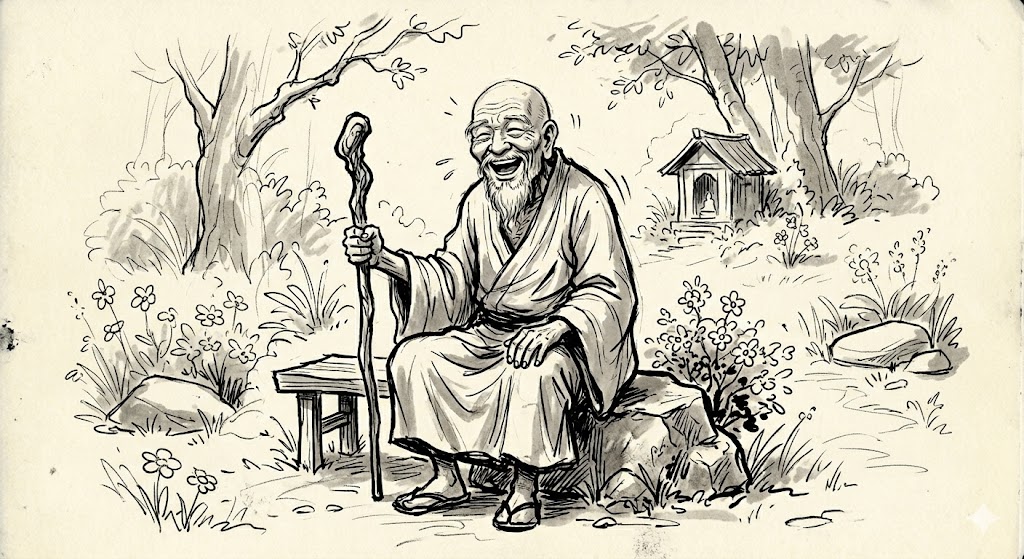
I saw the creature scurry across the floor in partial surprise. Cornering the beast, I felt resolute to end the game of hide-and-seek that we had been playing. As it sat helpless, frozen in the corner, I prepared to pounce and end this match once and for all. Yet a quiet memory surfaced from my time studying Zen Buddhism in my early 20s. Supposedly, because Buddhist monks felt compassion so deeply for all conscious beings, they would mindfully walk to avoid harming even the ants on the ground. The principle of non-violence in action. Moreover, they would even supposedly weep and repent if they killed but a single insect. So, as I looked at the spider, a moral indictment came upon me in the form of a question:
Why should I get to decide if this small consciousness lives or dies?
Holding a paper towel in hand as an executioner, I wondered quietly.
Supposing we believe ourselves to be “advanced intelligent beings”, it made me think about the Flatlander’s experience. This spider, so far as I knew, did not possess the computational capacity of my human brain, and perhaps did not even understand what its present environment was outside of immediate threat. Nor could it wrangle with my worldview or ethical curiosities debating its fate. Nature presents itself as amoral, it doesn’t have questions like this. Yet, I want to believe, because I like to hope sometimes, that there is a higher order orchestration going on that makes sense of all this meaning to the fabric of life business. Afterall, if I was just a Sim’s character for a higher dimensional intelligence’s simulation video game experience, I would hope it would have pity on me, and compassion so as not to make me suffer.
So having thoroughly prosecuted the existential morality of the situation, I proceeded to speak as kindly as possible to the spider, to climb upon the makeshift raft that I had constructed. For what felt like an arduous and absurd 15 minute period, I coaxed the creature and re-cornered it, until it confusedly stepped onto it’s freedom raft. Finally placed outside safely, the spider could spin their webs in new found freedom.
If you have been on this planet long enough, you have probably caused harm to something, someone or somehow – at least I know I have. It could be as simple as a slighted comment tossed mindlessly into conversation to fill space at the expense of another human. However, it may be as real as you harming someone you care about: withholding affection or love in performance, assuming the role of the savior, pushing to be right or to tear down a comforting illusion, or to try to fix something you see in error. I have done all of those, and more, maybe you have too.
I will confess that one honest struggle I have continually had in my life, is the dialectic conflict between three modes of being. The first is, living from my personal ego and self, filled with pride, vanity, envy, greed, and an innumerable number of human fallibilities including judgement, trying to get ahead and be important in the world. The second is the hope or belief in trying to follow or live according to time-worn principles contained in spiritual and wisdom traditions, such as compassion, understanding, nonviolence, detachment, et cetera (though sometimes it feels like a fool’s errand [1]). And the final mode is the more “Zen” perspective. That it is all somehow kind of a joke, really not to be taken so seriously. Essentially, a violent conversation between selfishness, selflessness and an old man on the park bench laughing at the two.
Therapy, psychology, and modern culture helps us to refine ourselves as persons deserving of and worthy towards love, respect, and individuality. We haven’t always been so lucky, and it’s important to realize how modern of a perspective that is. The culture uses words like boundary setting, self-respect, protecting your peace, and self-love. Yet these concepts feel hollow, in contrast to the ideals of compassion represented by saints, historic figures and even “teachers” such as Siddhārtha Gautama, Lao Tzu or Jesus Christ in spiritual traditions. When we hold these relics up to our modern lives, they feel far out of reach. If you typically overinvest in relationships that consistently reveal one-sidedness, looking at how Buddha would handle the situation doesn’t honour your humanity. It can be a form of self-abuse in extreme cases. Over time, we learn to become fierce about our persona, what we deserve, and focus increasingly inwards. It’s the formation and ego-refinement to a healthy self-esteem. It’s also what helps us to get by in a world where everyone is attempting to get their needs met.
Yet, excessive self-focus can become self-enclosure and therapeutic language can and is often used to dodge accountability and collective engagement; the processing becomes perpetual rather than generative. If an individual is honest they see that self-excess can produce a lonely hollowness. If everything is about my needs, where does the compromise and care in a relationship lie, and when is the right time to reach for compassion rather than self-righteousness? It’s not hard to see, if we’re earnest in how to live, a heavy heart with all this “self focus”. You have to form an ego before you can “dissolve it” toward a higher ideal. And while the culture says protect your peace, I’ve rarely had that problem, my instinct runs the other direction entirely.
Instead of self centeredness, a new goal is conceived: the ideal of the yogic doormat. This profound being accepts and loves everyone but demands nothing. He or she fawns or suppresses anger and removes all rational human boundaries that are seen as impediments to embodying traits towards human salvation. It’s the Sadguru image of being screamed at and being unphased (what a relief that would be!). We feel that by embodying a divine conduct of endless self-blame, compared to a messy human with some higher aspirations, that we will make right of existential suffering, in alignment to an usually performative enlightened way of living. This newfound persona, the “Spiritual Ego”, as it is sometimes called, has its own faults.
When we are hurt but operating in the mode of “Spiritual Ego”, we don’t operate from reality, but instead, from a veneer of it. What we struggle to see is that sometimes, the failure to act from our true spontaneous and messy human nature (e.g., “I’m scared because I don’t know how to do this”), we might prevent another person from being able to learn something about themselves or break a pattern in our life. If, when we are truly upset and choose fawn instead of dressing the wounded area from our partner or friend beating us with incendiary comments, we cyclically reinforce the same behaviour. The persona of endurance emerges and that’s all we think we can do. Why should the program outputs change if we never change the program inputs? It’s a risky game to play, because you believe that by controlling your lower impulses you’re being a “good person”, but, you may be generating maligned outcomes instead (ironic). So the question becomes, what are we to do if we can’t live up to these ideals in totality either?
Before cynicism draws too deeply from our well, one antidote worth looking at for this problem lies in the Buddhist path: the idea that one must first do no harm to themself. This is the remedy to someone using spirituality to rationalize harmful and sometimes unfortunately traumatic patterns they may be caught in. For example, a trauma victim staying in an abusive relationship for the pride to endure, or belief that they can win the other over by being loving enough. Complete bullshit. When we see that the very ideals we hold in positive intent are the paved road to our personal hell, it is time to snap out of the drunken stupor. The clever ruse that Buddhism deploys is the exploitation of our logic and conscience in wanting to be a “good person”. If we want to be a “good person” by extending loving kindness, compassion, understanding to “all beings”, then we must first realize that we too are necessarily part of the definition of “all beings”.
A common Buddhist prayer in the spirit of Metta reads:
For whatever harm I have caused others, may they forgive me.
For whatever harm others have caused me, may I forgive them.
For whatever harm I have caused myself, I forgive myself.
Paraphrased Buddhist mantra for forgiveness.
The third angle to this confusing trinity of being is the one with a bit of Zen taste. It represents a sort of self-erasure, not in the classical high-minded way, but towards one’s original nature. It is something touching on the Japanese concept of Kensho (見性), or seeing one’s true nature, which is a round about way to the forever endgame of the Eastern tradition that: “a fool in their folly will soon become wise”.
62
A nun asked, “setting aside the explanations given until now, please instruct me”
The master shouted, “Burn an iron bottle to ashes!”
The nun then went and poured the water out of an iron bottle and brought it to the master saying, “Please answer”
The master laughed at this
The Recorded Sayings of Master Joshu (1998)
I’ve always been drawn to Zen in part because it never asked me to be anything other than what I am: foolish, broken, flawed, confused, well intentioned, seeking, sometimes messy, but deep down like every other person, a human being trying to figure it out. In this way, Zen points to the conclusion without saying the words (that’s for the practitioner to find out). In saying so, however, I wouldn’t be my original nature if I wasn’t caught with some existential worry about creating harm or what to do about. It’s funny it feels like a game you can’t win, can’t quite lose either, but you don’t get to stop playing because we’re all interdependent beings who need each other [3]. Like the game show, Whose Line Is It Anyway?:
The rules are made up and the points don’t matter.
There is a Zen poem called Xin Xin Ming, Faith In Mind, which opens with:
The great way is not difficult for those who have no preferences.
It points, in part, to the ability to live without the seriousness to cast a vote of yes or no of what reality is presenting us. In other words, to not become outraged that our illusion has been breached, because we wish it were otherwise. For example, that we held someone to be one way because of their statements, and they ended up being something else. An alternative of this principle lies in the Chinese proverb of the farmer [4].
Once upon a time there was a Chinese farmer whose horse ran away. That evening, all of his neighbors came around to commiserate. They said, “We are so sorry to hear your horse has run away. This is most unfortunate.” The farmer said, “Maybe.” The next day the horse came back bringing seven wild horses with it, and in the evening everybody came back and said, “Oh, isn’t that lucky. What a great turn of events.” The farmer again said, “Maybe.”
The following day his son tried to ride one of the horses, and while riding it, he was thrown and broke his leg. The neighbors then said, “Oh dear, that’s too bad,” and the farmer responded, “Maybe.” The next day the conscription officers came around to conscript people into the army, and they rejected his son because he had a broken leg. Again all the neighbors came around and said, “Isn’t that great!” Again, he said, “Maybe.”*
Maybe.
Despite all this luxurious deattachment, something about that pesky human conscience creates dissonance, even if the harm we have caused is small. Because when we cause harm, it’s still harm. Zen itself doesn’t seem to dissolve conscience, but it can change our relationship to it, the Roshi, after all, meets the stumbling student not with judgment but with patient compassion. But, what about the rest of us?
It seems like none of the three ways of being gives a satisfying permenant fix. My personal ego still stumbles when it feels wronged, lashing out in dishing some “difficult truth”, self-deceptively convinced its from a place of pure care, when really it is probably tainted with a few brambles. I am still intensely drawn to the broken parts of people, probably because it feeds some part of my yogic doormat’s desire to embody compassion, to approach union with something sacred. And between the two, I can’t help but laugh at how silly I am.
The Buddhist concept of the Two-Truths doctrine helped me to understand personal opinions and how to come to peace with the hypocrisy we engage in. The first is relative truth (samvritti): it describes our everyday experiences. The second is absolute truth (paramartha), which states the ultimate reality is devoid of any moral fixedness. On a relative level I can say someone treated me very badly, hurt me deeply and be right. Yet, on the absolute level, they are also a confused human being doing the best they can with what they have in their knapsack. To judge is also to judge oneself, and everyone is fighting a battle you know nothing about.
If we have the capacity to digest the Two Truths, it can lead us to what Buddhists call the Brahmavihara or four virtues: mettā , karuṇā , muditā and upekkhā. These four immeasurables, if applied in symmetry to ourselves and the world, lead to a shift. To embody mettā, loving kindness, we move in a spirit of active good will towards all. In karuṇā, compassion, we identify the suffering of others as one’s own. In muditā, empathetic joy, we find the feeling of joy because others are happy, even if one did not contribute to it. And in upekkhā, equanimity, we stay steady as a mountain through praise or blame, merely contented with how things are. If we can hold these virtues, we see that through all faces and places our ego hides, we still find the reflection of self in connection with each other.
I’m reminded of the quote that:
Our suffering is proportional to the distance between how we wish or think things should be and how they really are.
Yet, all told, even basic Buddhist principles feel immensely difficult. I look at cases where I have failed immensely in equanimity: grieving connections that ended suddenly that lasted days but impacted me deeper than year long friendships; or ways that I have denied personal relative suffering as “less true” than “the ultimate truth”, because my yogic doormat just gets a kick out of endurance and feeling unworthy.
Jiddu Krishnamurti said that in order to create a revolution outwardly, we first require a revolution inwardly. In other words, it is the seeing of Sati, remembrance, the seventh element to the Noble Eightfold Path: forgetting is part of the practice. To realize when we have lost the breath in meditation we can still find it once more.
To see that if we have held ourselves to the goal of upekkhā, and not met it, not to collapse into self flagellation (guilty as charged) but also avoid flinching to the truth of our own misstep. If we see and admit to ourselves truthfully, we have caused harm, no matter the size, we see the virtue of karuṇā emerge: the pain we cause is a double ended sword, so we too feel the pain of our errors. If we aim to mettā, but feel like we failed when withholding affection to protect ourselves, we can remember we must avoid harming ourselves first, and that loving kindness begins first with us and then outwards. You cannot pour from an empty cup. Finally, if we hold grudges or reside in unhappiness for the well being of another, we see muditā, and how we only rot our own inner joy.
None of these principles mean that our mistakes do not have consequences, but it can help us to carry them with a lighter spirit. The reality is, we have all three modes of being within us, and giving ourselves flak for operating in one or two of three, betrays our basic humanity. Not because we do not aspire to great heights, but because we are not still image photographs, we are dynamic beings, figuring it out, making mistakes all the, time. It’s no wonder why every major spiritual tradition lays forgiveness as a major part of it’s core.
The question should not be, “How can I come to a permanent state of yogic doormatism so that I can never be affected again?” or “How to stop the feeling like I’m being compassionless, while still walking away from this abusive situation?”
Instead, it is to see truthfully and remember that awareness is not a constant, permanent state, but a continuous, gentle practice on and off the mat: to wake up every time you realize that you’ve fallen asleep and back three steps. We flex between all three states, all the time, and use discernment to know when and how to operate them. In that remembering, you can forgive yourself. And if you can forgive yourself, you may have the courage to ask forgiveness from another; not necessarily directly especially if doing so would bring about further harm or self-harm, but even in a quiet act of devotion or silent apology or Metta prayer to the other. Above all, the greatest apology that we can choose sometimes, is to embody a behavioral change as a symbol of our learning, even if the person who we have harmed may never reap the benefits.
Footnotes
[1] Not necessarily always if we view spiritual traditions as a method of ethics employed as a probabilistic cooperative evolutionary strategy.
[2] Milton’s Paradise Lost and the Intellect
[3] Fear, Cold, Connection