A grey, monochrome palette of clouds, interrupted by spurts of sunlight, painted the San Francisco sky. Overlooking John F. Kennedy Drive, I plant my carrying case and knapsack on the stone ledge. At the touch of a button, my small JBL speaker ignites, preparing the atmosphere. Opening the black case I had brought from the Uber, I gently unzipped the tabs to a worn-out DJ console. Within minutes, a few cords connected and setting my laptop straight, my signature park DJ session was about to be in store.
I started playing tracks as passersby smiled or rollerbladed through with definite 80s-style. Honestly, I always feel awkward about these interactions. To outsiders, my antics are an obvious cry for attention, and I can’t blame them either. As a DJ though, I never really cared about being seen. Regarded and desired for my musical ear, yes. Craving to share the splendid music library I built, of course (and I am guilty of enjoying a regular head pat too, I’ll admit it). But, I’ve never been keen to entertain a party or be the “hype man.” I’d often return the polite thumbs-up from park visitors with just a brief smile followed by a nosedive down at my console; my inner thoughts berating me in step.
Does everybody hate this selection?
Are they angry with me?
Oh God, do I look like a lunatic for standing here and just deciding to DJ?
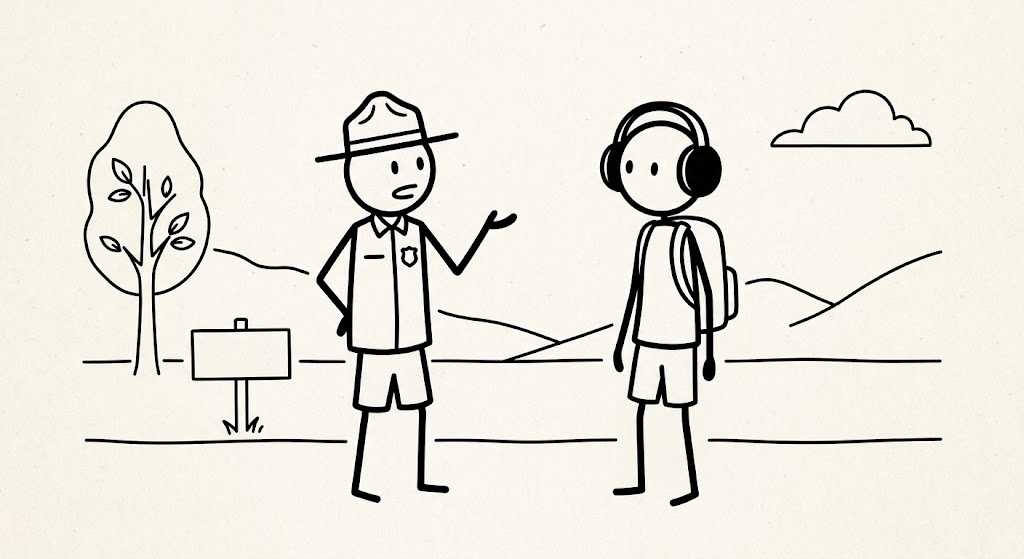
Naturally, these voices became less intense as time passed. So surprise struck when fifteen minutes into my set, the parting of SF’s gloomy clouds into a blue afternoon, that a uniformed ranger approached. His rugged face, that of someone with experience, stared from a distance. The patched green baseball cap complemented his blackout glasses that fixed themselves directly at me. Gripping his vest like tactical body armour facing an IED, he advanced with steady composure. Oh, shit. I thought.
Relocating to America allowed me an uncommon view of how life, work, and laws function in a country different from mine. Before then, I had never encountered an experience quite like working abroad. My university friends mentioned their immigration status from time to time, but they rarely included internal sensory descriptions that convey the experience of starting from zero. Although a work visa opens doors to new possibilities and aspirations, it also chips away at subtle confidences in the “alien” — the tender label assigned by the US tax and border authorities to non-citizens.
I always felt a low-grade tension and an ongoing edge. The devilish sentinel sitting upon my tight shoulders reminded me that at the slightest misstep or even an unlucky streak (e.g., losing a job in a layoff), everything could come crashing down. Pack your bags and head back to cold Canada. Day after day, the same tension softly prodded me. Everything from stopping myself from jaywalking to hand-picking eggshells out of my apartment’s trash can—I held in a hysterical fear of being cited and fined by the apartment building for failing to compost correctly (I’m not kidding). The “alien” faces intense internal scrutiny when performing many things that are freely done at home without hesitation. The same unease held me back from trying my first park mini-DJ set for some time.
“You know, you technically need a permit for that,” He said.
My stomach dropped, and a sense of panic ensued. Clearly, my pesky critic reminded me, I’d become too careless, indulging in a false comfort to show up and let off some steam on a Saturday afternoon.
“Oh?” I replied, gulping. Rushing to lower the volume fader on the mixer.
“Yeah,” The ranger replied, almost relishing in the moment.
My thoughts swirled.
Shit.
Am I going to get a ticket or be fined for this?
Will that affect my work?
Oh God, I still have four months left on my lease.
What happens if I am sent back home?
Suddenly the ranger’s stern face melted, mercifully, into a grin.
“Yeah, but it’s fine,” He said.
“You know, at my academy my captain used to say there’s the spirit of the law and the letter of the law. I see lots of people smiling here, and you’re not hurting anybody, so I think it’s fine.”
Relief cascaded through me. Smiling, I thanked him in a measure that bordered on that of a desperate job applicant; I was in disbelief. As the ranger walked on, I turned the volume up once more. Careful to keep the levels a notch lower than where they had been, just in case he reconsidered. Realistically, the JBL Charge 3 speaker could barely push more than 20Ws which is just loud enough to fill a backyard patio; there wasn’t much to worry about. And yet, you don’t know.
In his 2009 book Three Felonies a Day, civil attorney Harvey Silvergate argues that the vast increase of complex, ambiguous federal laws traps ordinary people in an almost impossible situation. The book describes how an average American can commit multiple felonies without realizing it through a series of case laws in a sympathetic argument. For example, in the United States v. McNab 1999 case, a Honduran seafood importer received eight years in federal prison over plastic-packaging regulations that even Honduras itself declared invalid. Although the book presents its thesis, it also faced justified criticism for exaggerated framing, selection bias, and challenges to legal precedent, such as the mens rea doctrine. For a felony charge to be made, a prosecutor must prove a guilty intent, for example. Even the US Department of Justice advises prosecutors not to bring trivial, technical, or accidental infractions when there is no clear public harm or criminal intent.
Yet, Silvergate’s concern about a continually expanding series of laws that becomes more opaque as time goes on isn’t without prior consideration either. The Google co-founder Larry Page, in that vein, pointed out at a 2013 conference that modern legal frameworks could benefit from some “pruning” now and then; the lack of expiration dates leads to a buildup in regulations that are hard to navigate. Page suggests governments consider, “For every law you add, take one away.” Despite being driven by logos, Page’s rhetoric includes a touch of pathos too. After all, a law clerk spends years revising before admission to the bar; so what can we expect from the average citizen when they try to understand the legal plumbing that affects their lives, businesses, or work each day? But maybe it’s not so simple either.
Essentially, modern law’s corpus functions as an archive of human conflicts and resolutions; long before formal contractual courts even existed, the Code of Hammurabi set crucial penalties for likely negligence. If humanity is graduating from the Age of Information to the Age of Intelligence, great complexity and therefore conflict seems the bare minimum. The consequences and enforcement in human terms, however, seem to depend on that delicate discretion the ranger lent me as wisdom in the park. The capacity to resolve conflict peacefully is the unending challenge for humanity.
C.S. Lewis said, “Every time you make a choice you are turning the central part of you… into something a little different from it was before.” Humans seem to choose good, or at least pro-social behaviour, because, consciously or not, it produces better long-term outcomes. Queuing in a line is basic rationality: single-file processing stops everyone from wasting time while two hotheads fight it out over ego. It’s the threat of consequences that creates these micro-orders. Unfair, self-serving behaviour yields short-term payoffs too, just at the cost of long-term stability. A system that mediates conflict without demanding perfect compliance seems to be what keeps a pluralist world from tipping over.
For honest people, though, at least those without a meteoric sense of righteousness, the capacity to be granted a pass in the law’s spirit is practically numinous if you think about it. While it’s hard to discount how fear of consequences helps police good behaviour, the benefit of having a tender line for tact is meaningful. Far from being a lawyer, legal philosopher, or public servant, I don’t make those calls or meditate on these ideas frequently. Nonetheless, the possibility for human judgment within an otherwise rigid, rules-as-written framework seems to offer an elegant preservation of habitability. In realistic terms, there are no actual laws in nature.
So, a park ranger sees a twenty-something kid DJing in a public park and decides not to make it a thing. A librarian waives a $40 late fee because a student clearly forgot, not because they didn’t care (they even brought the book back). An officer lets a kid off with a warning instead of a ticket for running an empty stop sign at 2am. They say jurisprudence is the study of justice, and it seems only natural to me that everyday grace is a part of that conversation, even if you don’t hear about it in the textbooks or tabloids.