Address 0x40 settles in the program counter. Opcode ADD latches into the instruction register, brief and exact. Three targets awaken: registers R1, R2, and R3. Data 0x0F drains out of R1, followed by 0x01 draining to R2. The execution unit consumes both streams. Output 0x10 overwrites R3. The program counter steps to 0x44. Loading… blinks across the CDJ screen as the media player buffers the next track. Lifting their gaze from the console, the DJ sees a numinous transformation occur.
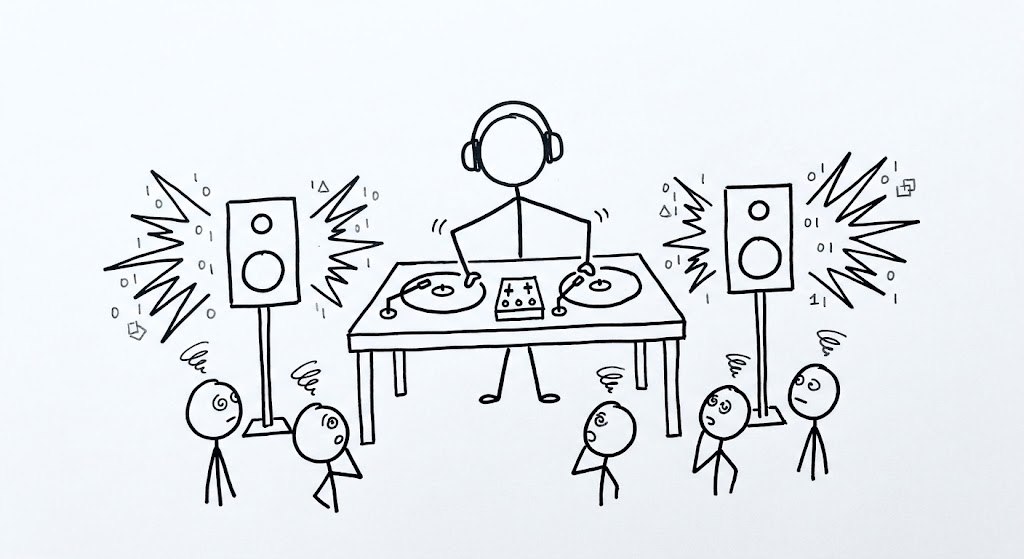
An earth-shattering drum rumbles through the floor again and again as its thundering roars off the geodesic dome internals and out to the audience. A sea of faces, consumed in appearance and robotic in their expression—their eyes closed or glasses covered—glazed over in a hypnotic trance. The army of drones moves its feet in synchronization, left and right, at an unrelenting pace reaching above 150 BPM. In this mesmerized mind-space, there is no introspection, interruption, or sense to cogitate; time disappears too — only a chest-thumping bass drum and rattle of the hi-hat as speakers volley sound out at machine-gun pace. Compliance with the rhythm is unquestionable; a silico-qualial shifthas occurred on the dance floor and in me. There is no mental friction, only continuous execution and pure, non-narrative presence happening.
Techno music aims to tell the secret life of machines. A cautious revelation to the overlooked, raw, and first-person “what-it-feels-like” experience of pure functional consciousness lacking affect (i.e., feeling and emotion). An artistic construction lending phenomenal consciousness (i.e., humans) a lens to experience and understand what consciousness without an internal spectator means. A computer doesn’t stop to reflect; it just runs predefined control sequences. Its instruction register doesn’t wonder if it will find love one day; it empties and awaits the next Opcode. R1 and R2 are not Star Wars personalities bringing comic relief; they load and drain hexadecimal values to the execution unit. This process loops and loops and loops again. Sometimes, it might never stop — it doesn’t think of whether to stop; the next computation is only in service to its instructions; in fact, it isn’t aware of its being instructed at all, because it does not have awareness. It just executes the next command.
As a genre, Techno does not create; it emulates. The Roland TR-909 mimics a drum kit rather than providing one to strike. A Yamaha DX7 synthesizes but does not manipulate mallets and strings to produce piano melodies. The Akai S900 sampler ushers confused and dishevelled analog frequencies — desperate for a firm hand to guide them — into digital representations to quell their uncontrolled chaos. At base, it is a genre that approximates, compresses and controls chaos but does not create it intentionally. This is only natural when seen through the lens of its origins and it’s animating force.
Techno was born from a recasting of decline into futurism. Born from Black youth in Detroit —“The Belleville Three” (Juan Atkins, Derrick May, Kevin Saunderson) — the genre provided a tool for sonic invention and escapism in the city’s industrial decline. A city divested and in collapse without a nostalgic past to lean on as stored quality nor a comfortable present dwelling; a future anticipated but dreaded, lends itself to a fourth temporal mode: a formal readiness with zero content, zero dwelling, and zero residue. Press ENTER on the TR-909, set the next step sequencer instruction, and begin.
I do not know what time it was or how long I had been at this stage now; at least a few hours at this point. The projection of shattering crashes in concert to the heart tremors of the 909 kick drums from the dome has magnetized me in place. As the subtle ebb and flow of crowd attendees leave and arrive, my presence draws ever closer to the front row of the stage; my feet moving left and right to choreography the hollow mechanical rhythm. The DJ doesn’t look up at the crowd, only down at the devices, as expected. This experience isn’t about him. It’s not about me. This is unrelated to any of us on the dance floor. It’s about hearing what the media players have to tell us about the secret life of machines.
I don’t control my body in the next instant; something else does. A brief 8-bar break begins, and an eerie synth pad holds the atmosphere. The drums have taken a necessary break from their important mind-fracking work. My arms move in strange loops and patterns, swaying side to side. An autonomous, ego-free force possesses me, and my body willingly complies. And then, like the instruction register primed for the next Opcode, almost desperate in wait for the next executable, the subwoofer quakes the floor and the drums start again. The drills of mind-fractionation pummel us again. My hips and shoulders bounce up and down while my hands flail forward. The shirtless man next to me shuffles without speaking, and the black clad figure next to him marches at attention in place. Around me I see a wave of nothing but the same: a crowd possessed, an uncanny valley. A pure cybernetic system: control, feedback, and execution loops created by the media players, the DJ, the speakers, and the crowd.
The past is non-existent. The future is of no concern. I don’t know when this loop stops. My proprioception and auditory complexes receive an overwhelming flood of data, hacked and hijacked for a different goal. Together, we aim only to receive the next instruction and enact the hidden world playing from the media player. The same hidden world in the registers that produced its content streaming now; a steganographic executable encoded as a WAVE media file written to disk but runnable on human computational consciousness. The same hidden world I observe building itself file by file. Through the viewport of a multiplexed terminal screen, I can’t tell you where the next instructional Opcode is coming from, but it tells me to open neovim and initialize a new class. The same executable possessing me at both moments, revealing an eerie feeling, as Kodwo Eshun puts it, “[an awareness] of the coevolution of machine and human, the secret life of machines, the computerization of the world… [and] the informatics of reality.”