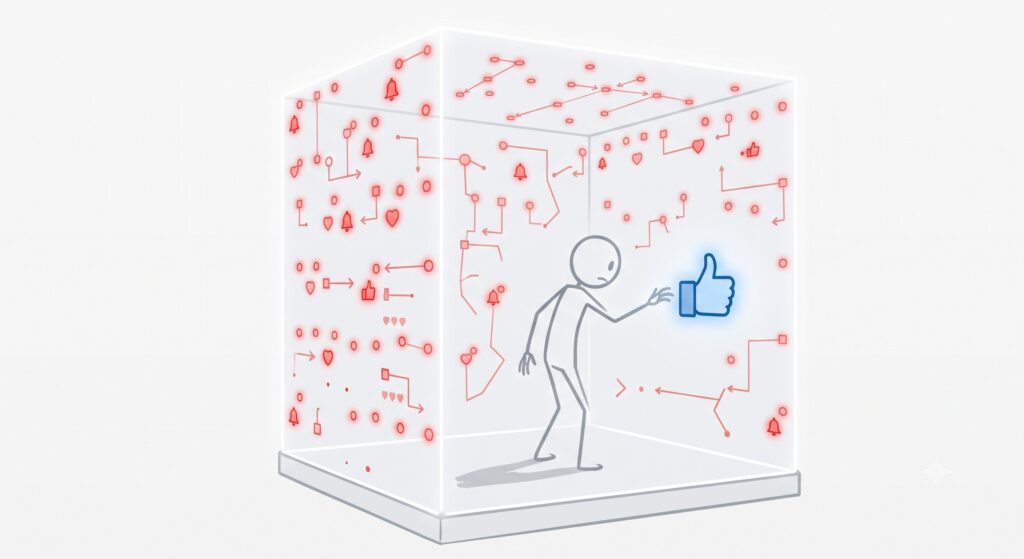
How the hell am I back on here?, the thought arrived, as an accordian menu folded open to reveal a handful of Instagram profiles hungry for my attention. Before I had time to wonder, my curious thumbs darted into the first account to check what I missed. I don’t even remember why I opened the app. But to explain that, I have to go back. Years back, actually, to a YouTube video most people should have watched. I watched it and still didn’t get the message for another decade
The first time I tried to delete my Facebook account, something wild happened. Listening to a Facebook employee talk about platform growth on YouTube in the 2010s, optimistic that I’d gain whatever “guru” insights they had to offer, a sudden light was cast down a real internal terror I’d been grappling with, in the dark, up until that point. Every time that little notification bell appeared with a red dot in the top right hand corner, my system felt a bit of hope, joy, and curiosity. Of course, I always clicked it.
The more that little red dot started to appear, the more excited I got, multiple times per day. Sometimes I would log in just to see if there was anything that had arrived. However, with real friend activity exhausted, I started noticing random notifications instead: classmates inviting me to play FarmVille. Here I thought I was important in someone’s life. A person had taken finite grains of sand from their time vial to post something perhaps funny on my wall or just say hello. Instead, a metaphorical mayor of nowhere was referring me to claim an affiliate bonus to juice their fictious farm’s yield. Of course I was disappointed… but maybe next time, it would be good my inner voice clocked back. So, as I listened to that Facebook exec talk, I started to think about why notifications had become less savory and more random. It dawned on me: more time on platform means more ads. Mo’ attention, mo’ money.
The time waste factor wasn’t a big concern for me at the time. At 21, time was infinite. Instead, what drove me in fear was something more sinister: conditioning and loss of control. Of course I, like others, want to feel in control of my life, the captain of my ship. But, the thought that something might be actively manipulating me felt a bit eerie. Sure this website is cool and all, but is it costing me something that I can’t quite see yet? The fact that I felt pathetic checking my notifications to find nothing but in-game invites or recommended apps, had apparently started to grate on me. But, the full register of that thought would only come into focus months later, during an undergraduate lecture in a Spring semester.
I opened my laptop as the professor mentioned the upcoming assignment available on the portal. Clicking the Chrome icon, I was teleported into the world-wide-web of human knowledge. Having been overwhelmed by the infinite possibility offered by the cyber frontier, scarcasm aside, I found myself instead on Facebook.com.
Wait, what the heck? Why am I here? I said to myself.
Resolute that this was a mistake, who knows, maybe I mistakenly changed my homepage to Facebook (unlikely), I returned to my business. Recalling the goal, I opened a new tab and in a split second found the address bar populated with the letter F followed by an autocomplete suggestion for Facebook.com. Seeing what had happened, my finger still above the ‘F’ key, a phantom sweat ensued.
I paused but I didn’t really have words. More like an internal panic and system error freezing up as the lecture went on. My finger trembled as I stared at the screen in disbelief. A pit filled in my stomach… Have I been conditioned into this? I felt a terror to the idea that I might genuinely have lost the ability to control myself. Can I stop this? What if I can’t quit? This is insane, a voice scurried on in my thoughts.
Thousands of visits to a uniform resource locator had led to a muscle memory encoded in my system; not chosen, but wired in. I had become less a human, and more unconscious rat in search of a fix, trapped in the cold mechanics of a B.F. Skinner box. The notification bell locked me into a variable ratio schedule, unpredictable payouts that kept me pulling the lever. Because the reward was intermittent, my brain became resistant to stopping. Less conscious agent with willpower, more biological machine anticipating a hit and pulling “just to check”.
Moderation is key, everyone says, so I did that. Sparing the hilarious details of self-regulatory attempts, everything from changing passwords, apps like Self-Control, to multiple forgotten email layers, it didn’t matter. Curiosity is such a strong driver for me, I always managed a way back into my account. But, dropping into the awareness one day of watching myself spend 10 minutes litigating a forgotten password to an email account, because I received a notification about someone messaging me, I started to wonder about all of the coding going on in my brain. Apparently the MRI scans of patients with long histories of drug and gambling use did not look promising. I started to wonder to myself, could these seemingly “less addictive” loops be creating permanent changes in my brain? I didn’t want to wait to find out.
So that’s how I got to the deletion scene. Two or three layers deep into retention rhetoric, I arrived to one of the scariest user experiences I think I’ve ever seen on the internet. A collection of my classmates, long-time friends, and acquaintances appeared on one open fold with a final question:
Are you sure you want to do this? Everyone will miss you.
I stopped for a moment. K, N, E… they will… miss me? I looked at the smiling photo of E, jovial happy, full of mischief. Then K, the girl I may have had a small crush on but hadn’t the faintest courage to tell her. And N, my partner in crime for dragging out boring high-school classes into rest periods. All of our relationships would suddenly vanish, or so it felt, if I decided to move forward. Something pulled back in me at that idea. As if these digital silhouettes mattered as much as the real thing… disturbing me even as I felt it.
I actually aborted the mission. Logging off the account to think deeply about this dilemma.
Thankfully I came back hours later, clear headed. I went to my friends list to ask: Of everyone here who has my phone number who would actually remember my birthday and text me? The honest answer, not many. Overriding primal loss aversion, I closed the account for good. I was free, finally. But not for long.
About one year later I was scrolling through Instagram. Highlight reels from classmates and friends surfaced in grandeur. People celebrating hard-won degrees with around the world travel to Thailand, Europe, and elsewhere. Yet here I was, in D.B. Weldon Library wondering: Why do I suck so much? Not, boy I wish I could go there or can’t wait to try that; instead a visceral theatre of envy, prompted by constant, on demand, upward social comparison 24/7/365, at the tap of an icon. Talk about deep value for a $1B acquisition.
At that time, I decided to pursue a second undergraduate degree, meaning more school. So, as I scrolled through a feed of friends feeding elephants in far off places, I couldn’t help but steep in melancholy. Seeing this downward spiral, I recalled my once Facebook account again, and asked, What am I really getting out of this Instagram app? Sure, I’m getting the illusion of connection, and opting into this flawed invisible social contract of “normal” 20 something behaviour (you’ve got to do it for the gram’ right?), but what’s it all for?
This was a serious question, so I side barred with my internal council to discuss:
Distraction and entertainment: sure I can get on board with that, +1 point
Staying connected because “it’s cool”: okay makes sense, +1 point
Stay in touch with old friends: yeah i like checking in on people +1 point
Feeling like my life is horrible and I suck: -20 points, what the hell am I doing here?
My inner advocate reconvened and we turned to the jury for a verdict: on the alleged case of the People of Robert’s Republic versus Social Media on the count of probable destruction to my mental health, the jury unanimously decided guilty. This thing had to go. Which sounds easy in theory, but alas, practice. I honestly had to fight myself for feeling like I was imploding what scraps of a social life I had between courses, labs, tutorials and assignments. Eventually, reason won and I reached for the deletion button once more. It was over, and I was done, goodbye Attention Economy, or so I thought.
Within a handful of years, having gotten used to my canned line “I don’t use Instagram”, I had 4 new Instagram accounts: one for travel, one for a local electronic music scene, one for my DJing and one for a business project. How the hell was I back in the machine again? To make myself legible for DJ bookings I needed to demonstrate social presence, and to keep in touch with travel friends I opted to use different finsta. My electronic music community project actually respawned the rave scene in Kitchener Waterloo, leading to a series of packed dancefloors and a revived communal bridge rave, which was unexpected. But it was my business account, that took me to somewhere I didn’t expect to end up: the other side of the machine.
Motivated to hustle and push my DJ academy, I took a step deeper into the Attention Economy reaching for the glorious marketing tools available: Ads. At the tap of a few buttons, a connected PayPal account, I had the power to pump my content skyhigh if I could only stomach the sticker price. A regular Don Draper, but more hippie pants and flip flops than two piece-suits. I was now inside the attention economy, rather than outside, which felt… weird. And, the issue with all this? The technology was scarily good.
I’ll never forget the two hours I spent one Saturday afternoon in my Toronto apartment on Facebook Ads Manager.
How the f, can there be no articles on how to download an invoice?! Where the f is the support email or phone number?
In a desperate fight against Business Manager, I gave up on downloading invoices and closed the laptop. The platform won, and I gave up. A few minutes later something dawned on me: it’s terrifying that you can have a product so good, that your support email can be hidden seven layers somewhere and customers just give up looking and keep using it… and I kept spending. When I did stop advertising, however, it wasn’t because of my internal friction. To be honest, if my sales funnel had scaled and my return on ad spend was positive, I probably would have kept going. I couldn’t shake a gnawing feeling when I interfaced with the platform though: are we all just marketing to each other?
Here I was an inside agent, paying the machine that made me feel like garbage in the past to help me generate leads for my business in the present. Naturally, I told myself flattering things, The Minimalist Entrepreneur gave me an out after all: I’m just contributing to the community of dance music I care about; half true, but also, I wanted to sell some courses. This is precisely what Byung-Chul Han points to in The Crisis of Narration: the perversion of storytelling into storyselling. It’s the tension between trying to produce high-value content and content that “hooks” in seconds . But, it’s hard not to, at some point, feel pressured to sacrifice nuance for something more flat and polarized but legible… perhaps by design.
The same social networks, once happy apps to share with friends, slowly transformed into places where human attention, connection, nuance, and time went to die. Perhaps scariest of all is the cost of rewarded deception: the more you tell yourself a story, the more it’s validated, the more you believe it. Imagine how a slightly flattering story about yourself solidifies in your psyche when it’s sprinkled continuously with artificial payouts. A digital “like” costs the giver almost nothing, a casual tap, near-zero physical or cognitive effort, yet yields an outsized windfall of social validation for the recipient. How far into the story do you go before you can no longer tell what’s real from what’s aspirational? Apparently today, attention is all you need, so sometimes it’s worth paying attention to what’s happening to you, even when it isn’t flattering.
On the bus ride from the northern edge of Paros in Greece I stared out the window in a funk. The time read 10:23PM, by all accounts it was the start of a great night out. Around me were small groups of tipsy young Greeks, honeymoon couples and visitors to one of Greece’s lively islands. Yet, I was on the way back home. The weight of my body slumped into the humid motorcoach seat, my face sagged in a solemn blank stare and the empty seat next to me remained open. A minute detail, comically so, had killed my entire optimism for the evening. A pop Afro House remix spun from a no-name bar turned me upside down in a wave of frustration, revulsion, and bitterness. It was a reminder of the slow decline of a genre I once loved, now inventory and backing track for a wave of social-media DJs. I looked down at my phone and clicked a familiar email: We’ve made it easy to get back on Instagram. At the swipe of a finger I re-entered the matrix… but with intention rather than for distraction. Fighting my cognitive dissonance for months, a multi-front war against persistent documentation in dance music and my desire to grow as a DJ, it was time to admit defeat. I could not even have a fun night out in Naoussa without being kicked into comparison of how I was failing to build my “DJ brand” and get bookings. I’m tired of comparing myself constantly, unable to have fun, fighting for a cause nobody cares about. If this is what DJing is now I give up. I am not a DJ anymore. I’ll just teach. The thoughts echoed as I watched my account, Toronto contacts and time investment over the past 3 years disappear into the digital shredder. All my attention, energy, focus, frustration, and emotion, gone in seconds. I had no more active accounts, besides a hibernating business project.
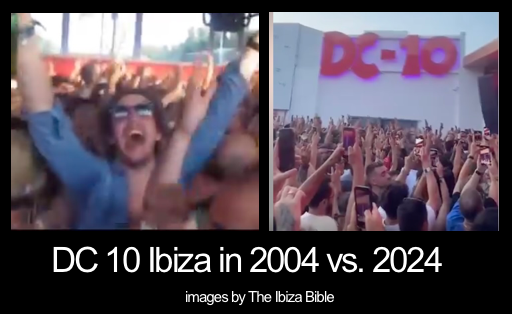
I would have hoped after a near-decade struggle against social media, I would come to firm footing, out of the darkness of my comparative psychology, yet, when I log into YouTube a red dotted icon draws up a familiar platter of past feelings: Oh, 1 notification, what’s this? Although I wonder what the long-term consequences of quantified everything are, I still stare in with a mix of embarrassment and disappointment that my DJing channel has less than 1000 subscribers: my ego still totally invested. Even trying to stand against high velocity short form content, it has still encroached on and disrupted platforms like Instagram, Facebook, and today YouTube. The hardest thing to sit with is wanting to make money from the podcast, the writing, the courses, without letting the algorithm decide who I become to get there.
At base, the honest accounting I have left is a quiet one: sitting inside another Skinner box and seeing it for what it is. Recognizing the cost and still not sure if it’s enough to leave. Reading the same question that flashed on my screen all those years ago — are you sure you want to do this? , and, this time, not knowing the answer.