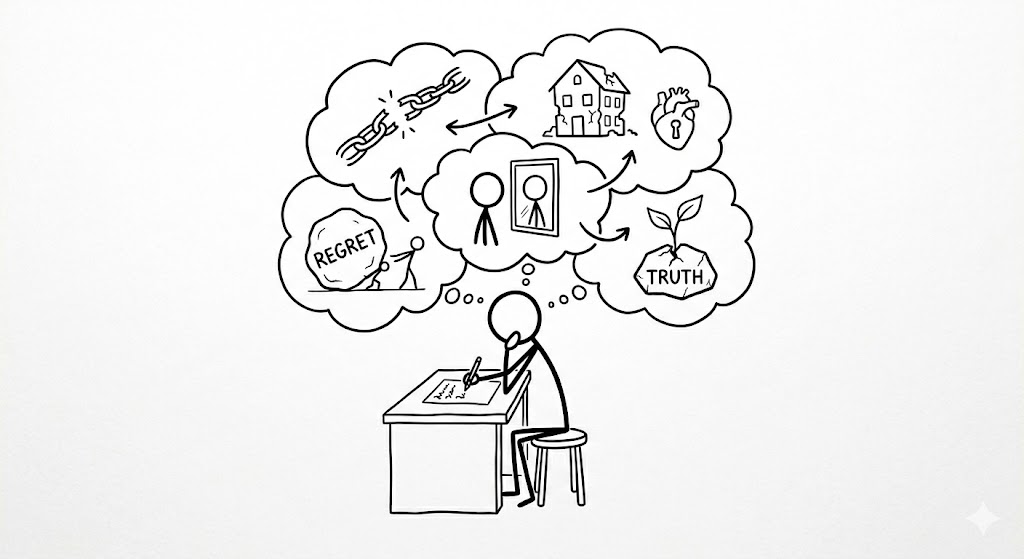
Self-confession can bring steadiness through self-intimacy.
There is a saying,
Sunlight is the best disinfectant
At bottom, it means that truth, in revelation, clears malady. I think it applies to both the inner and outer world. With regards to the “inner world”, I am referring to the idea of mind or what I call the “me”. Metaphorically, the “me” is a constellation or planet in the void of space, or and better, a lone island (ego) in the wide ocean (unconscious).
The “me” is composed of years of residue held onto, as put by Michael Singer in The Untethered Soul, and best illustrated by Robbie Bent during his Dark Cave experience:
My biggest takeaway today was that the mind is a wild animal. No control over your thoughts and the same loops. With no stimulation, the thoughts take on a much more noticeable role. It’s like “why am I thinking about these things, and really, again?
As you notice your thoughts, it’s trivial to see how negative thought loops dominate our waking life. These residues lie, subconscious, until activated by experience or remain superficially in awareness, like a misplaced dirty shirt hanging out in your room; a nuisance but sometimes not enough to consciously take the time to action and clean up. The “me” is a collection of thought loops repeated again and again, conditioned and conditional at times, vocalized, sometimes inaudibly, as your “inner monologue”.
Here’s an example:
I really don’t know where I am going in life do I?
Oh maybe it’s okay not to know.
Oh but I really should.
How will I be successful?
Ah my friend is doing so well in life, they just launched a new product.
Why can’t I just get it together and be like that?
Meditation can help us become aware of that inner dialogue. But meditation, in the definitive sense of the word, also means to:
[to engage with a] contemplative discourse, usually on a religious or philosophical subject.
There is the passive form of meditation, sitting in in half, full or no-lotus, which can bring stillness to the mind; however, there is also intentional contemplation engaging with the inner dialogue that can yield stillness too.
This form of intentional contemplation, “meditating” on the “me”, I am going to venture and bid is avoided with the greatest diligence, if only in my anecdotal sense. It is terrifying to step inward and observe the weight bearing walls of what we hold most deep to our sense of “me”. It is, more too, scary to think that much of our daily dialogue might be out of control; subtle and harmful lies that loop over and over again. Fire. Wire. Condition. Encode. Repeat.
If we can become aware of them, can we listen to them, and change them?
Becoming a good listener is an sublime gift. In the Co-Active Model for coaching, there are three levels of listening:
Level 1 Listening – listening primarily to your own thoughts or agenda. This is where your mind is not focused on what the other person is saying.
Level 2 Listening – are intensely focused on what the other person is saying. Nothing distracts you. Thoughts about the past or the future don’t intrude. Your ideas don’t get in the way of hearing the other person.
Level 3 Listening – directed towards the other person but has a broader focus. You hear more than just their words — you pick up on body language, inflections, tone of voice, pauses, and hesitations, becoming more aware of the whole person.
When it comes to conversations with strangers, I notice changes in mannerisms, behaviours, and detail in their speech, depending on a given topic or depth. These subtle cues are sticking points to expression. Such sticking points relay the relative comfort, intimacy and depth held in a conversation. Often, when a person gets “stuck”, it is usually some internal truth that they fear expressing due to vulnerability or appearing weak; the person would prefer to keep the veneer of acceptability or false strength over honest expression. At times sticking points can elucidate so-called “shame tapes” conceptualized by Brene Brown.
I find the cartography of humanity fascinating, and therefore, prefer to explore as far as I can into a person’s motivations and inner life, so long as they are comfortable. But, why am I talking about any of this? Because in the same way that a conversation is a dialogue, you yourself have an inner dialogue that is tunable depending on your personal courage and intimacy to venture forth.
My mind was racing, anxiety and upset filled me, in a frenzy towards self-lamentation I prepared to flog myself.
“Why can’t I just ‘be better’?”, I asked myself without reply.
But what was it that bothered me so much about myself? Oddly, at times we’re absolutely livid with ourselves without merit to our criticism: CBT based therapies aiming to challenge this complex. But CG Jung describes in his autobiography Memories, Dreams & Reflections,
A collective problem, if not recognized as such, always appears as a personal problem, and in individual cases may give the impression that something is out of order in the realm of the personal psyche. The cause of the disturbance is not to be sought in the personal surroundings but rather in the collective situation. Psychotherapy has hitherto taken this matter far too little into account.
I volunteer that the reason the “personalization problem” happens is out of fear to pierce the social sphere and expose ourselves towards the possibility of shame. Shame is, at bottom, the exile function of a collective leading to pure loneliness. From the exiled perspective, shame serves to concretize the fear to inadequacy and alienation and it leaves one stuck. From the inner group’s perspective, it is the protective mechanism to generate boundaries of who belongs and who does not to a given collective.
So I asked myself in that state of upset,
“What if I wrote out everything I’m ashamed of and bothered about myself?”
Wouldn’t it help to just get it out all on paper, all the “terrible things” that I felt and failed at in reaching up to a social definition of “belonging”? This started the process of self-confession and demarcated a path towards greater self-intimacy.
What I noticed, after seeing the two or so pages I managed to write, was that the inner heaviness causal to the vague residue “hanging around” in my head, lifted. There it was, all the things I felt inadequate about; yet it did not hold the same weight it did when unvocalized. There’s something powerful about honesty and truth to oneself if only for your own purposes.
As Jim Rohn says,
You don’t have to tell everyone in the neighbourhood about it, but admit your mistakes to yourself.
Inward honesty gives a sense of steadiness and clarity that cannot be found outside ourselves. But what we often do instead is lie to ourselves. We minimize, ignore and pretend it does not matter. Just leaving the dirty clothes to keep piling up until it gets really bad. The clothes pile so high that you can no longer open the door and that’s when you explode.
This is, in a way, the thesis of The Anatomy of Peace:
Each time we ignore that inner conflict or idea we betray ourselves in search of a validation or source of satisfaction that is not renewable.
Inward honesty, not lying to ourselves, might just be the real validation and comfort that we are seeking from one another (at times) or in distraction or avoidance. So if you are aimlessly bothered or stuck, it might be worth asking yourself to be honest and say the thing you feel most afraid to say. At least you can know, you’re not lying to yourself about where you are at.