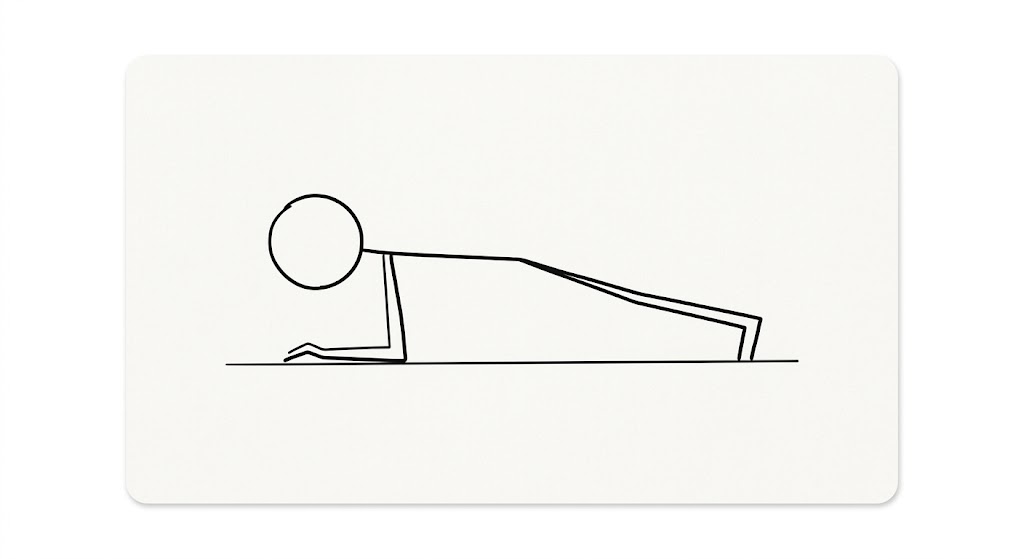
To do a plank..
Correctly..
Is a hard thing to do.
The instructor announced as we listened on the veranda of a steamy Costa Rican morning in San Jose.
Often, it looks easy to do from the outside…
Because we do not see the effort required,
From the inside.
Immediately, a Tibetan singing bowl was struck in the background: an elongated ringing followed by a trailing silence circling off into eternity – we held planking on our big toes. Naturally, it wasn’t just Tibetan bowls that filled our awareness; there was pain, muscle weakness, fatigue and a burning question of, “how much longer will I hold this pose? Will I fall out it; Am I falling out right now?”.
The instructor continued the monologue in his characteristic dead-pan tone:
“Did you know that,
You can smile…
With your inner child,
Whenever you want to?
I giggled at the simplicity of this statement, but kept my gaze down at the mat.
You can smile with it…
At the grocery store…
When you wake up…
When you go to work…
When you go to bed…
While you do yoga…
While you do a plank,
You can smile with your inner child,
Whenever you want.”
Again the singing bowls crashed and my the momentary childishness and waning fatigue swept away… there was only the ringing, the anticipation of the next bell, the silence, and internal quiet that ensued. My entire self, swallowed up into that reverberating single tone – washing away the “me”.
“Inhale…
Exhale….
Down dog.”
A communal relief swept through the patio. We paused for a moment in our resting posture, then:
“Inhale.
Sounded the instructor as we prepared to move to the next act.
Right foot, forward.
Lift up.
Left foot, pivots.
Arms, up,
Look, forward.
Warrior Two.”
A tension held in the air of the class, the sharpness of a warrior’s sword to compliment our battle stance.
Then at once, I was thrusted from my meditative concentration – barking dogs, shouting voices, car horns sounded in the background.
“Focus.”
I said internally; reaching back into the posture, squeezing my legs tighter, pointing my arms with greater precision; could I fix my arms so sharply that they could cut through that noise?; could I become so still as to be completely indifferent to these annoyances? To any annoyance?
Sweat poured down my arms and face, feeling each bead roll slowly, gazing still, core constricted, body pleading for release.
“In Yoga…”
The instructor offered; none of us moved.
“There is an idea, called integration.
Sometimes… we hear sounds,
That we think are distracting…
But instead of allowing them to disrupt our focus…
We integrate them…
We absorb them into our practice,
We see them as no different,
From any other sound of nature.”
Eventually, we sat up looking to the instructor in the final meditation posture, as he spoke:
“You may notice…
The sensations you feel in the body,
After all these postures.
In Yoga… we do a variety of different postures
Some simple postures,
and some complex ones [like Ashtanga poses]
They are all complex movements…
Movements… that are grounded in the breath.
But you might notice your body, feels,
At ease as it moves through these changes.
Because we watch the breath,
And we continue to practice.
But did you know..
There is an even more complex movement than these ones?
The most complex movement,
Is the movement in your mind.
A constant movement to be aware of. “
The class dismissed and I folded the yoga mat up turning over the idea again and again:
The most complex movement of all, the real practice, is awareness of the movement of the mind.